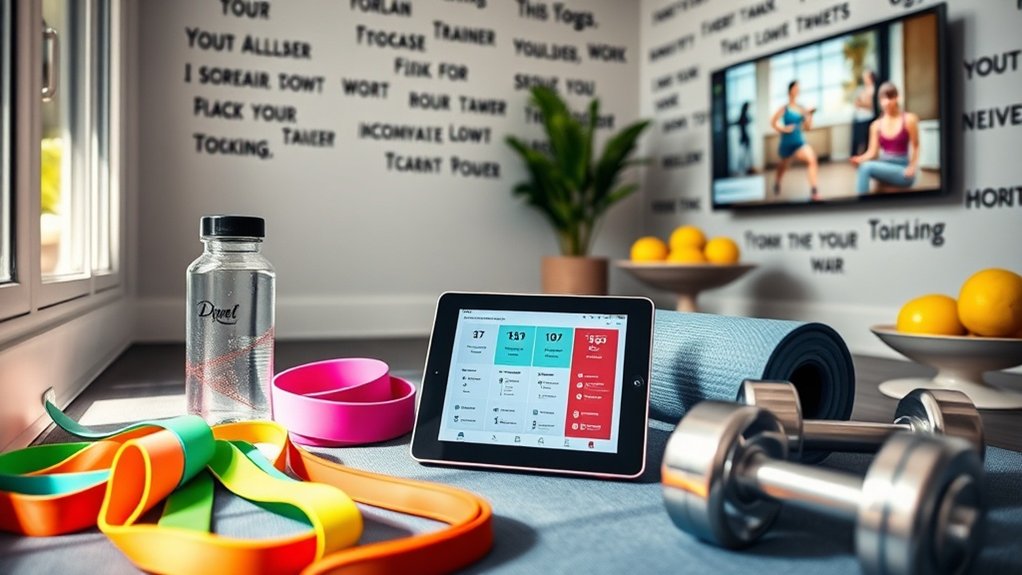

You’ll achieve comparable muscle hypertrophy to free weights using resistance bands through progressive elastic tension that increases force output during band elongation. Select bands ranging from 5-150 lbs in 100% natural latex, then stack them for customized resistance profiles matching your strength curves. Execute compound movements like deadlifts, military presses, and lunges with controlled tempo while maintaining proper joint alignment to minimize injury risk. Progressive overload occurs by strategically adding bands every 4-6 weeks, and you can integrate them with bodyweight exercises for improved training density that maximizes your portable fitness results.
Understanding Resistance Band Training: Benefits and Science of Variable Resistance

Resistance bands generate progressive tension through elastic deformation, creating what exercise scientists call “ascending resistance”—a mechanical property where force output increases proportionally with band elongation.
This variable resistance pattern guarantees your muscles work harder at peak contraction compared to traditional weights, which provide constant load. You’ll experience improved muscle fiber recruitment throughout the entire movement arc, particularly during the concentric phase when most strength gains occur.
These versatile resistance bands deliver measurable improvements in both strength and endurance while minimizing joint stress—critical for injury prevention.
The elastic properties allow precise load adjustment without equipment changes, facilitating safe progressive overload. Research confirms comparable muscle hypertrophy outcomes to free weights when you maintain consistent training protocols.
Their adaptability accommodates rehabilitation requirements and various fitness levels effectively.
Selecting the Right Resistance Bands: Types, Resistance Levels, and Equipment Guide
Before you can implement an effective training protocol, you’ll need to match equipment specifications to your biomechanical requirements and training objectives.
A thorough Resistance Band Set should include multiple configurations to target various muscle groups effectively.
Consider these essential selection criteria:
- Band typology: Loop bands maximize lower-body biomechanics, tube bands with handles facilitate upper-body movements, and mini-loops enable isolated muscle activation.
- Resistance gradation: Exercise bands spanning 5-150 lbs accommodate progressive overload principles across different resistance levels.
- Material composition: 100% natural latex guarantees superior elasticity coefficients and structural integrity under cyclic loading.
- Accessory components: Handles, ankle straps, and door anchors expand exercise versatility while maintaining proper joint alignment.
You can stack multiple bands to progressively increase tensile load, enabling systematic strength adaptation while minimizing injury risk through controlled resistance curves.
Essential Resistance Band Exercises for Complete Full-Body Development

With your equipment properly selected, you can now construct a systematic training protocol that maximizes neuromuscular adaptation across all major movement patterns.
Your resistance training equipment enables targeting all muscle groups through compound movements: deadlifts activate posterior chain musculature, military presses develop shoulder girdle stability, and lunges challenge unilateral lower-body strength. This full body approach guarantees balanced muscular development while preventing compensatory movement patterns.
Execute each exercise with controlled tempo, maintaining proper joint alignment throughout the eccentric and concentric phases.
Your fitness routine should progressively overload muscles by adjusting band tension from 5 to 150 lbs as strength increases. The included exercise guides provide anatomically-specific protocols for abs, arms, and legs, guaranteeing thorough muscular engagement.
Prioritize form quality over resistance magnitude to minimize injury risk while optimizing adaptation.
Progressive Resistance Band Programming: Building Strength With Portable Equipment
Strategic manipulation of band tension creates a scientifically-validated pathway for progressive overload, the fundamental mechanism driving neuromuscular adaptations and hypertrophic responses.
Progressive resistance band programming enables you to systematically advance toward your fitness goals by stacking bands from 5 to 150 lbs, guaranteeing continuous muscular challenge.
Your workout options expand as you master each resistance level:
- Initial Phase: Start with single bands to establish proper form and movement patterns
- Intermediate Progression: Stack two bands when you can complete 12-15 repetitions with controlled tempo
- Advanced Loading: Combine three or more bands to achieve hypertrophic stimulus
- Deload Protocols: Reduce resistance by 20-30% every fourth week to prevent overtraining
The included exercise guide provides structured progressions, while the equipment’s portability guarantees training consistency across environments.
Maximizing Results: Combining Bands With Other Training Methods and Overcoming Limitations

Although resistance bands deliver substantial neuromuscular adaptations when used in isolation, integrating them with complementary training modalities creates synergistic effects that boost strength gains, metabolic conditioning, and movement quality beyond what single-method programming achieves.
You’ll maximize training density by pairing workout bands with bodyweight exercises—adding accommodating resistance to squats, push-ups, and lunges increases time-under-tension while maintaining proper biomechanics.
Fitness enthusiasts can strategically stack multiple bands to customize resistance profiles matching specific strength curves. When training with bands at home, secure anchoring systems and adjustable attachment points eliminate stability limitations inherent to elastic resistance.
Incorporate bands into Pilates, yoga, or rehabilitation protocols to improve proprioceptive feedback and motor control. Combining bands with traditional weights creates variable resistance patterns that challenge muscles through complete ranges of motion, developing functional strength across multiple movement planes simultaneously.
Frequently Asked Questions
How Do I Clean and Maintain My Resistance Bands?
Clean your resistance bands with mild soap and water after each use, then air-dry completely. Apply proper maintenance tips like talcum powder to prevent degradation. Store in cool, dry band storage solutions away from direct sunlight to maximize longevity.
Can Resistance Bands Replace Gym Memberships Completely?
You’ll find resistance bands coincidentally excel where gyms struggle: affordability comparison favors bands, workout effectiveness matches free weights for muscle activation, and space convenience suits home training. However, you can’t replicate heavy progressive overload or specialized equipment safely.
Are Resistance Bands Safe for Seniors or Pregnant Women?
You’ll find resistance bands safe when following proper safety guidelines. For pregnancy modifications, you should maintain lighter tension and avoid supine positions. Senior exercises require controlled movements and appropriate resistance levels. Always consult your healthcare provider first.
How Long Do Resistance Bands Typically Last Before Replacement?
Like rubber tires wearing down, you’ll need replacement after 6-12 months of regular use. Durability factors include band types (latex versus fabric), storage conditions, and UV exposure. Watch for replacement signs: visible cracks, reduced elasticity, or surface deterioration indicating structural compromise.
Can I Use Resistance Bands if I Have Joint Problems?
You can use resistance bands for joint health with proper precautions. They’re commonly employed in physical therapy for low-impact rehabilitation. However, you should consult your healthcare provider first to determine appropriate band exercises and resistance levels for your specific condition.