
You’ll build an effective Smith machine program by selecting compound movements like squats, bench press, and rows while using the machine’s safety catches for confident solo training. Start with 2-3 sets of 10-15 reps as a beginner, progressing to 4-5 sets of 6-10 reps as you advance. The fixed bar path maintains proper form and eliminates spotter requirements, though you should balance your routine with free weight exercises for ideal stabilizer muscle development. Understanding when to strategically implement each training modality maximizes your strength gains while prioritizing safety.
Understanding the Smith Machine: Design, Function, and Training Applications

The Smith machine transforms traditional barbell training through its distinctive fixed-rail system, which guides the barbell along a predetermined vertical or near-vertical path. This design improves your stability and reduces injury risk during exercises.
You’ll find multiple notches for adjusting bar height, accommodating various movements and starting positions. The Smith machine offers built-in safety pegs that enable you to train confidently without a spotter—particularly valuable for solo sessions.
If you’re a beginner, you’ll benefit from learning proper lifting mechanics while the fixed vertical rails minimize form errors. The guided motion isolates specific muscle groups, increasing activation during your workouts.
These training applications make the equipment versatile for extensive strength development, from squats and presses to lunges and rows, supporting your progression safely.
Smith Machine Vs Free Weights: Muscle Activation, Safety, and Performance Differences
When you’re choosing between the Smith machine and free weights, you’ll find that each offers distinct advantages backed by research.
Free weights activate more stabilizing muscles and typically produce greater overall strength gains, while the Smith machine provides improved safety features and controlled movement patterns that reduce injury risk during solo training.
Understanding these differences in muscle activation, safety benefits, and performance outcomes will help you select the most effective tool for your specific fitness goals and experience level.
Muscle Activation Comparison Studies
Since understanding muscle activation patterns directly impacts your training decisions, let’s examine what research reveals about Smith machines versus free weights.
Studies consistently show free weights generate higher muscle activation, particularly during squats and bench presses, because you’ll recruit more stabilizing muscles. However, this doesn’t tell the complete story for your training success.
Key research findings you should consider:
- Smith machines deliver improved form and control, enabling better isolation of your target muscle groups.
- The safety advantages let you train to failure without a spotter, potentially increasing training volume and growth.
- While activation levels run slightly lower, the consistent movement patterns facilitate predictable strength progression.
Your choice ultimately depends on your experience level, training goals, and whether you’re working out solo—where Smith machines offer significant safety benefits.
Safety Features and Benefits
Beyond muscle activation numbers, your physical safety during training demands equal attention—especially when lifting heavy without a spotter.
The Smith machine’s adjustable safety catches let you rack the barbell at any point during your lift, preventing dangerous situations if you can’t complete a rep. This fixed bar path guides your movements to maintain proper form throughout each exercise, while free weights require constant balance adjustments that can compromise technique under fatigue.
Research confirms that the Smith machine’s stability features reduce the risk of form-related injuries during solo training sessions.
You’ll push heavier loads confidently, knowing the built-in safety mechanisms protect you. The controlled environment particularly benefits those learning new movement patterns or recovering from injuries.
Strength Gains and Performance
While both training methods build strength effectively, the differences in how they challenge your body directly impact your overall performance gains. Research shows that free weights activate more stabilizing muscles, boosting functional strength.
However, you’ll still achieve significant muscle building results with Smith machines, particularly when you’re prioritizing safe solo workouts without a spotter.
Your strength training choices should align with your experience level and goals:
- Free weights engage additional muscle groups through natural movement patterns, improving athletic performance and coordination.
- Smith machines allow you to lift heavier loads confidently during safe solo workouts, maximizing muscle isolation and mechanical tension.
- Beginners benefit from the Smith machine’s guided bar path while developing proper form and building foundational strength.
Both methods deliver measurable strength gains when programmed correctly for your fitness journey.
Building Your Custom Smith Machine Workout Program: Exercise Selection and Form Guidelines
Your Smith Machine program‘s effectiveness depends on three foundational elements: selecting exercises that target all major muscle groups, maintaining proper form throughout each movement, and systematically increasing training demands over time.
You’ll need to establish clear criteria for choosing compound and isolation exercises that align with your specific goals while making sure balanced muscular development.
Before adding weight to the bar, you must master the technical checkpoints for each exercise and implement a structured progression system that safely challenges your muscles without compromising form.
Essential Exercise Selection Criteria
Because the Smith machine’s fixed bar path fundamentally changes how your muscles work compared to free weights, you’ll need to select exercises that capitalize on this unique advantage rather than fight against it.
Your exercise selection should follow three essential criteria:
- Choose compound exercises that engage multiple muscle groups simultaneously — squats, bench presses, and Romanian deadlifts deliver maximum strength-building efficiency while the machine’s guided path lets you focus entirely on proper form.
- Balance your program between upper and lower body movements — pair exercises like seated shoulder presses with squats to prevent muscular imbalances and guarantee thorough development.
- Adjust bar height and safety pegs to match your body dimensions — this customization protects your joints and optimizes muscle activation throughout each movement’s full range of motion.
Proper Form Checkpoints
Perfect execution separates productive Smith machine training from wasted effort and potential injury. You’ll need specific checkpoints for each movement to maximize results while training solo.
For back squats, position your feet shoulder-width apart and guarantee your knees track over your toes as you descend until thighs reach parallel.
During incline bench presses, set your bench between 30-45 degrees and maintain 45-degree elbow angles to protect your shoulders.
Romanian deadlifts require a slight knee bend with hip-hinging movement, keeping the bar close to your legs throughout.
When performing seated shoulder presses, start at upper chest level and press overhead without back arching.
For reverse lunges, step backward while keeping your front knee aligned over your ankle.
These form checkpoints transform Smith machine exercises into safe, effective movements.
Progressive Overload Guidelines
Progressive overload forms the foundation of every successful strength training program, and you’ll need systematic guidelines to apply it safely on the Smith machine. When you can complete 12-15 reps comfortably, increase weight by 5-10% while making certain you maintain proper form throughout every movement. This calculated approach prevents injury while maximizing gains.
Key Implementation Strategies:
- Track your workout progress by recording weights, sets, and reps in a training log to identify patterns and make data-driven adjustments.
- Incorporate exercise variations like different grip widths or foot positions to prevent muscular adaptation and breakthrough plateaus.
- Prioritize controlled movements with proper joint alignment over heavier loads, especially when increasing intensity levels.
Complete Smith Machine Training Templates: Beginner to Advanced Programs
The Smith Machine offers a structured framework for lifters at every experience level, from those taking their first steps in strength training to seasoned athletes pursuing specific performance goals. Each template below provides evidence-based progressions that prioritize safety while delivering measurable results.
| Level | Exercises & Volume | Training Focus |
|---|---|---|
| Beginner | Squats, bench press, rows (2-3 sets × 10-15 reps) | Build foundational strength and movement confidence |
| Intermediate | Add Romanian deadlifts, overhead press (3-4 sets × 8-12 reps) | Improve muscle engagement and promote hypertrophy |
| Advanced | Supersets and circuits (4-5 sets × 6-10 reps) | Maximize strength gains and muscular endurance |
You’ll adjust weights and rep ranges systematically to facilitate progressive overload. The adjustable safety catches enable confident solo training, allowing you to challenge yourself without compromising form or security.
Safety Protocols and Progression Strategies for Solo Smith Machine Training
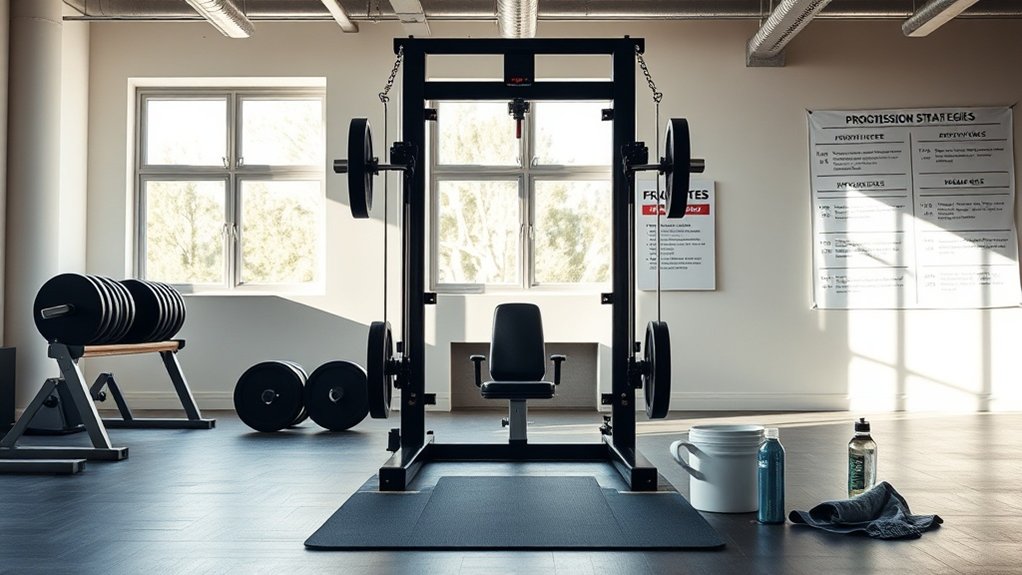
When training alone on the Smith Machine, your safety system starts before you load a single plate. Your safety protocols must include proper setup: position those safety pegs at the right height to catch the bar if you fail a rep. This simple step transforms risky solo workouts into controlled training sessions.
Your progression strategies should prioritize technique over ego:
- Start light: Master movement patterns with minimal weight before adding plates
- Warm up systematically: Prepare your muscles and joints through structured routines
- Track everything: Log your weights, sets, and reps to monitor safe progression
The machine’s built-in locking mechanism offers multiple bailout points throughout each exercise. Use these hooks strategically—they’ll build your confidence while protecting against injury during challenging lifts.
Optimizing Results: When to Use Smith Machine Vs Free Weights in Your Training Split
Strategic equipment selection will directly impact your training outcomes, and understanding which tool serves your specific goals prevents wasted effort in the gym.
Smith Machine Workouts excel when you’re prioritizing safety during heavy squats or overhead presses, especially when training solo. The fixed bar path reduces risk of injury while you’re learning proper mechanics or recovering from setbacks.
However, research shows free weights activate more muscle fibers and build functional strength through unrestricted movement patterns.
You’ll achieve superior results by strategically combining both approaches. Use the Smith machine for targeted isolation work and stability-dependent exercises, then incorporate free weights for compound movements like deadlifts that benefit from natural bar paths.
This balanced split develops complete strength while maintaining safety protocols throughout your training program.
Frequently Asked Questions
How Safe Is Using a Smith Machine Alone?
Using a Smith machine alone is very safe when you follow proper safety precautions. The machine advantages include fixed bar paths and adjustable catches, making solo training secure. You’ll maintain correct form while confidently lifting without requiring a spotter’s assistance.
What Is the 3-3-3 Rule in Gym?
Think of it as your strength blueprint: the 3-3-3 rule involves three sets of three reps at heavy weight. This three-phase training approach follows workout intensity guidelines while emphasizing gym safety tips for progressive strength development.
What Is the 3 2 1 Rule in Gym?
The 3-2-1 rule isn’t a standard training technique. You might be confusing it with other gym safety tips or workout efficiency methods. Focus on proven training techniques like progressive overload and proper form to maximize your results safely.
What Is the 5 4 3 2 1 Workout Program?
The 5 4 3 2 1 workout program uses a descending set breakdown where you’ll perform five exercises with decreasing sets (5-4-3-2-1), progressively increasing workout intensity levels. Training frequency guidelines recommend 3-4 sessions weekly for ideal recovery and strength gains.