
Progression in your personalized workout plan works through systematic increases in training stress—whether that’s adding weight, increasing reps, or manipulating tempo and rest periods. You’ll track load, volume, and perceived effort weekly, then apply progressive overload at a rate matching your recovery capacity. Your plan cycles between intensity phases (heavy weights, low reps) and volume phases (moderate weights, higher reps) every 4-6 weeks to prevent plateaus. Strategic variation in exercises, rep ranges, and training modalities guarantees continuous adaptation tailored to your goals and lifestyle demands.
Understanding Progressive Overload as the Foundation of Adaptation

When you step into the gym with a goal to transform your body, progressive overload becomes your most powerful ally. This fundamental principle demands that you gradually increase the stress placed on your muscles through higher weights, additional repetitions, or reduced rest periods.
Your body responds through adaptation mechanisms, becoming stronger and more efficient when faced with escalating demands. The overload principles guide you to push beyond your current capacity systematically—research suggests a 10% weekly increase in weight or volume keeps you progressing safely.
Without this strategic approach, you’ll plateau quickly. Your personalized workout plan must incorporate regular performance assessments, adjusting training variables to guarantee continuous advancement.
Progressive overload isn’t optional; it’s the foundation of every successful transformation.
Quantifying Progress: Tracking Load, Volume, Reps, and Perceived Effort
You can’t improve what you don’t measure, which is why tracking your load, volume, reps, and perceived effort transforms guesswork into measurable progress.
These metrics provide concrete data that reveals whether you’re truly advancing toward your strength, hypertrophy, or endurance goals.
Measuring Load and Volume
Three fundamental metrics form the backbone of any successful strength training program: load, volume, and repetitions. Understanding how to measure these elements transforms guesswork into strategic progression.
Load tracking captures the weights you’re lifting, while volume optimization multiplies your sets, reps, and load to quantify total training stress.
Here’s how to implement effective measurement:
- Record your load for each exercise to establish baseline strength levels.
- Calculate volume by multiplying sets × reps × weight to monitor weekly workload.
- Document incremental increases in load (2.5-5% jumps) to guarantee sustainable progression.
- Compare week-over-week data to identify patterns and adjust intensity accordingly.
This systematic approach eliminates ambiguity and provides concrete evidence of your advancement, empowering you to make informed decisions about when to push harder or recover strategically.
Repetition Range Adjustments
While load and volume provide the structural framework for your training, repetition ranges serve as the precision dial that fine-tunes your results.
You’ll experience distinct repetition benefits across different ranges: 8-15 reps effectively develops both strength endurance and muscle growth for beginners, while advanced lifters can periodize between 3-6 reps for pure strength and 12-15 for hypertrophy.
Track your perceived effort on a 1-10 scale, targeting 7-8 intensity during strength sessions. Record every rep completed at each load—this objective data reveals when you’re ready to progress.
Prevent plateaus by cycling through different ranges every 4-6 weeks. Your body adapts to specific demands, so manipulating rep ranges guarantees continuous adaptation.
When you consistently hit the upper range with proper form, it’s time to adjust.
Rating Perceived Exertion
Beyond the weight on the bar and the reps you complete, your internal gauge of effort holds the key to optimizing every training session. Rating Perceived Exertion (RPE) transforms subjective feedback into actionable data, accounting for individual variability that numbers alone can’t capture.
RPE applications in your training:
- Rate each set from 1-10 to quantify how challenging the work feels in real-time.
- Track patterns between RPE scores and actual performance to identify recovery needs.
- Guide training adjustments by comparing intended versus actual effort levels.
- Recognize off-days early when RPE feels disproportionately high for standard loads.
This personalized metric guarantees you’re training smart, not just hard.
When you’re honest about perceived effort, you’ll make precise adjustments that accelerate progress while preventing burnout.
The Role of Tempo and Rest Intervals in Driving Progression
When you’re pushing for real gains in the gym, the details between your reps matter just as much as the weight on the bar. Tempo manipulation—like using a 2-2-1 cadence—amplifies muscle tension and metabolic stress during each set.
You’ll create more time under tension, which directly fuels hypertrophy and strength adaptation.
Rest interval strategies are similarly critical. Shorter breaks (30-60 seconds) spike hormonal responses that promote growth, while longer periods (2-3 minutes) enable recovery optimization for maximal power output.
Tempo variations combined with strategic rest periods give you precise control over progressive overload.
Track these variables consistently. When you monitor tempo and rest intervals alongside weight and reps, you’ll identify exactly what’s driving your progression forward.
Weekly Linear Progression vs. Block Periodization Models

You’ve mastered tempo and rest intervals—now it’s time to structure your long-term progression strategy.
Weekly linear progression and block periodization represent two fundamentally different approaches to building strength, each with distinct advantages for your specific goals and training experience.
Let’s examine how these models work and which one will accelerate your results.
Weekly Linear Progression Explained
As you map out your training strategy, understanding weekly linear progression becomes essential for building sustainable strength gains. This straightforward approach delivers clear progression benefits by systematically increasing your training loads each week, making it ideal for beginner strategies when you’re first developing your foundation.
Your weekly linear progression follows a structured path:
- Start with manageable baseline weights that allow proper form while challenging your muscles.
- Increase loads by 2.5-5% each week, creating consistent adaptations without overwhelming your recovery capacity.
- Monitor your performance metrics to identify when adjustments are needed before hitting plateaus.
- Maintain focus on your primary goal rather than cycling through different training emphases like block periodization does.
This method keeps your training simple yet effective, confirming you’ll continuously challenge yourself while building the technical proficiency needed for long-term success.
Block Periodization Structure
While weekly linear progression builds strength through consistent incremental increases, block periodization takes a strategic pivot by dividing your training into distinct phases—each engineered to develop specific adaptations that compound upon one another.
You’ll focus intensely on one quality—whether hypertrophy, strength, or power—during each block duration, typically lasting 3-6 weeks. This phase emphasis allows your body to adapt deeply without the accumulated fatigue that derails linear models.
Here’s why this matters for you: by alternating between high and low-intensity phases, you’ll recover more effectively while building upon previous gains.
Research confirms that advanced lifters achieve superior strength improvements through this approach. Your programming becomes surgical—each block strategically prepares you for the next, preventing plateaus and overtraining while accelerating your progress toward peak performance.
Choosing Your Model
Understanding these two powerful frameworks is one thing—but selecting the right model for your unique situation determines whether you’ll optimize your gains or spin your wheels.
Match your model to these criteria:
- Experience level – If you’re new to lifting, weekly linear progression delivers rapid strength gains through straightforward goal setting and minimal complexity.
- Training consistency – Linear models demand week-to-week progression, while block periodization accommodates life’s interruptions through longer adaptation phases.
- Performance goals – Pursuing multiple qualities (strength, size, endurance) simultaneously? Block periodization rotates focuses strategically. Chasing pure strength? Linear progression keeps it simple.
- Recovery capacity – Advanced lifters need block periodization’s structured recovery periods to prevent overtraining, whereas beginners recover faster between sessions.
Your choice isn’t permanent—reassess as you progress.
Alternating Between Intensity and Volume Phases
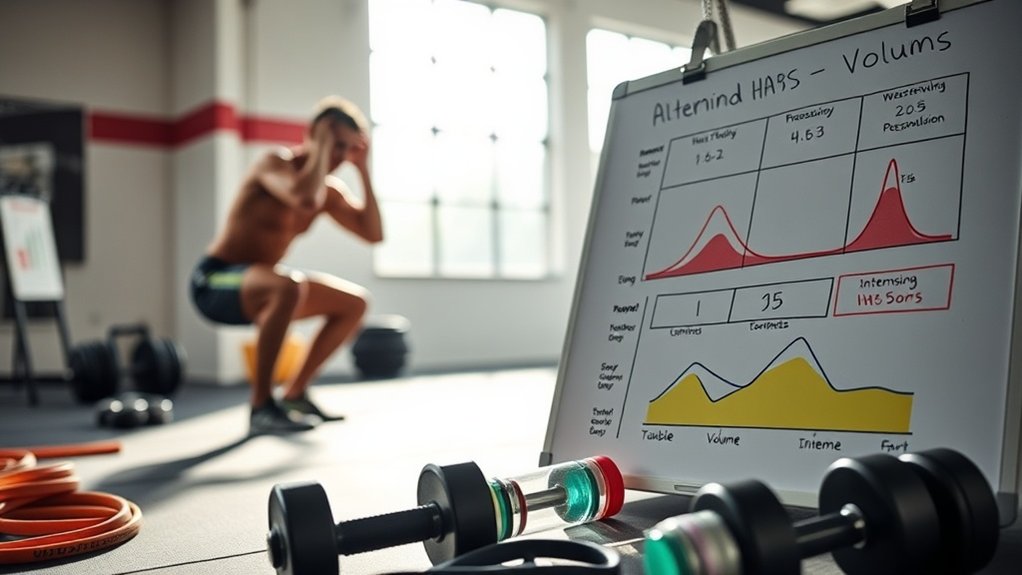
When you’re pushing your body to new limits, cycling between intensity and volume phases creates the strategic variation your muscles need to keep adapting.
The intensity benefits come from your 3-6 rep sets with heavy weights, building raw strength and explosive power during 3-6 week blocks. You’ll then shift to volume adaptations, where 8-15 rep ranges with moderate loads drive endurance and muscle growth.
This alternating structure prevents plateaus by challenging your body through different pathways. You’re not just training harder—you’re training smarter.
Your volume phases also provide essential recovery from demanding intensity blocks, reducing injury risk while maintaining progress.
Track your performance metrics throughout each phase. Your strength gains and endurance improvements reveal whether your program’s working, allowing you to adjust and optimize your progression.
Breaking Through Plateaus With Strategic Variation
Even with perfectly timed intensity and volume phases, you’ll eventually hit a wall where your usual progression strategies stop delivering results.
That’s when strategic variation becomes essential for continued muscle adaptation.
Here’s how you’ll break through:
- Rotate training modalities between strength, endurance, and flexibility work to challenge your body’s systems differently.
- Adjust workout frequency and exercise variety every 4-6 weeks through structured periodization.
- Conduct regular fitness assessments to refine goal setting and implement targeted recovery strategies.
- Apply motivational techniques by setting micro-goals that celebrate small wins during plateau periods.
This multifaceted approach guarantees you’re constantly presenting novel stimuli to your muscles, preventing stagnation while maintaining the progressive overload principle that drives real transformation.
Aligning Progression Rate With Individual Recovery Capacity

Your muscles don’t grow during workouts—they grow during recovery, which means your progression speed must match your body’s ability to rebuild and adapt. Individual assessments of recovery indicators like heart rate variability and perceived exertion reveal when you’re ready to advance. Pushing harder without adequate recovery sabotages progress and invites injury.
| Recovery Capacity | Progression Rate | Key Indicators |
|---|---|---|
| High (younger/conditioned) | Faster increases | Quick HRV recovery, low soreness |
| Moderate (average fitness) | Steady, measured | Normal sleep, moderate fatigue |
| Lower (older/beginner) | Gradual progression | Extended soreness, raised resting HR |
Monitor your body’s feedback consistently. Adjust training frequency and intensity based on performance metrics, not arbitrary schedules. Strategic rest days aren’t weakness—they’re optimization tools that transform recovery capacity into sustainable strength gains aligned with your unique physiology.
Tailoring Progression Timelines to Personal Goals and Life Context
Because your life circumstances shape your training capacity as much as your physical abilities do, effective progression timelines must account for both your specific goals and the reality of your daily demands.
Your plan succeeds through customized milestones that reflect your unique situation:
- Goal-Specific Pacing: Fat loss goals demand different progression speeds than strength building or athletic performance improvement.
- Life Stage Integration: Your age, work schedule, and family commitments determine realistic workout frequencies and intensity increases.
- Adaptive Scheduling: Regular assessments trigger timeline adjustments when life changes or progress stalls.
- Recovery Windows: Built-in deload weeks prevent burnout while accommodating your stress levels and past injuries.
This personalized approach transforms generic programs into sustainable systems that evolve with you, confirming consistent progress without sacrificing your wellbeing.
Frequently Asked Questions
What Is the 3-3-3 Rule for Workout?
Studies show 70% of people quit workouts due to confusion. The 3-3-3 rule simplifies your workout frequency: three exercises, three sets each, three segments. You’ll master exercise intensity while staying consistent, making progress clear and achievable for your fitness journey.
What Is the 5 5 5 30 Rule?
You’ll perform five sets of five reps at 75-85% 1RM with 30-second rests between sets. The 5 5 5 benefits include efficient strength gains and muscle growth, while 5 5 5 applications work for both beginners and advanced lifters.
What Is a Progression in a Workout?
Think of progression as your fitness ladder—you’re constantly climbing higher by systematically increasing workout intensity through heavier weights, more reps, or advanced exercises. This strategic approach triggers exercise adaptation, forcing your muscles to grow stronger and surpass previous limitations.
What Is the 4 8 12 Rule?
The 4-8-12 rule guides your progressive overload: increase upper body lifts by 4%, lower body by 8%, and compounds by 12%. Its benefits include consistent strength gains, while its applications help you systematically track progress and break through plateaus.