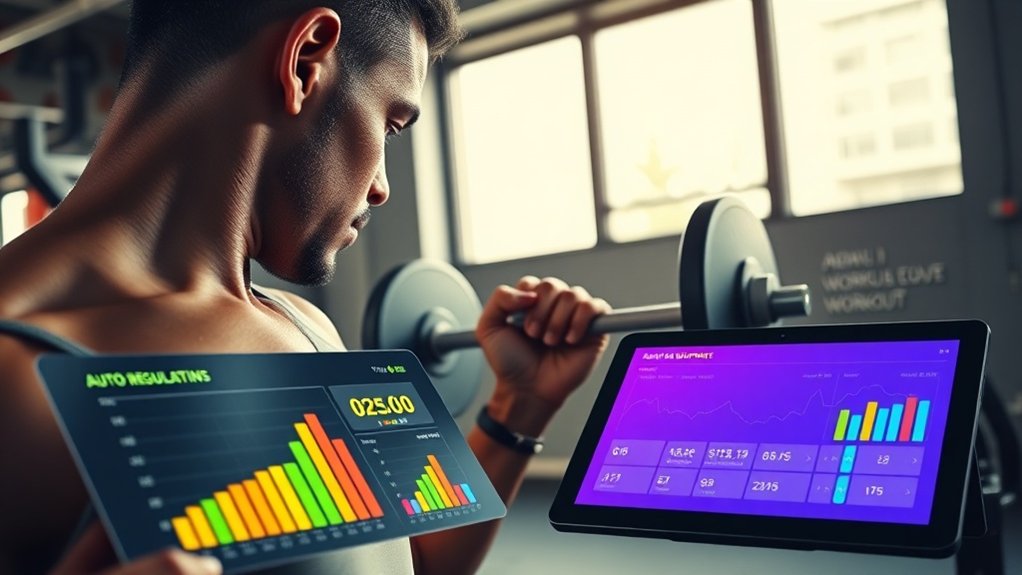
Auto-regulation adjusts your training variables—intensity, volume, and exercise selection—based on real-time neuromuscular readiness rather than following predetermined protocols. You’ll use subjective tools like RPE (Rating of Perceived Exertion) and RIR (Repetitions in Reserve) alongside objective measures such as countermovement jump performance to assess daily recovery capacity. This approach optimizes hypertrophic adaptations while reducing overtraining risk by modulating training stress according to your central nervous system readiness and hormonal status. The framework transforms rigid periodization into a responsive system that accounts for physiological fluctuations throughout your training cycle.
What Is Auto-Regulation in Training?
Auto-regulation represents a dynamic training paradigm that manipulates workout variables—intensity, volume, and frequency—based on real-time physiological and psychological readiness markers rather than predetermined programming schedules.
This methodology acknowledges that fluctuating stress levels, accumulated fatigue, and recovery capacity considerably influence your daily performance capabilities.
You’ll employ self-assessment tools like Rate of Perceived Exertion (RPE) and Repetitions in Reserve (RIR) to gauge exertion levels and modify sessions accordingly.
This approach emerged as a counterpoint to rigid periodization frameworks, prioritizing training flexibility over fixed progressions.
By addressing individual needs through continuous performance feedback, you’re better positioned to optimize strength and hypertrophy adaptations.
The system fundamentally respects your body’s physiological signals, enabling personalized adjustments that traditional programming often overlooks.
Why Static Training Programs Fall Short
While traditional periodization models provide structured progression frameworks, they operate under the flawed assumption that your neuromuscular system, endocrine function, and psychological state remain constant across training microcycles.
Static programs ignore athlete individuality by prescribing uniform training loads regardless of sleep deprivation, accumulated psychological stress, or fluctuating recovery capacity. This rigidity compromises training adaptation—your body’s ability to respond effectively to imposed demands varies greatly day-to-day based on allosteric load and homeostatic shakeion.
Research demonstrates that fixed-intensity protocols increase overreaching risk when you’re inadequately recovered, while underusing training capacity during peak readiness states.
Tools for Measuring Daily Readiness
To implement effective auto-regulation, you’ll need reliable methods for quantifying your neuromuscular readiness before each training session.
Subjective measures like RPE and RIR provide immediate feedback on perceived capacity, while objective protocols such as CMJ height and RSI offer quantifiable neuromuscular performance data.
Combining both assessment categories creates a thorough readiness profile that accounts for physiological status and perceptual load tolerance.
Subjective Readiness Assessment Methods
Many athletes struggle to determine whether their bodies are prepared for high-intensity training on any given day, yet subjective readiness assessment methods provide practical solutions to this challenge.
Rate of Perceived Exertion (RPE) uses a 1-10 scale to quantify the perceived difficulty of each set, enabling you to gauge your physiological capacity based on current neuromuscular fatigue levels.
Repetitions in Reserve (RIR) measures how many additional repetitions you could complete before reaching muscular failure, offering real-time insights into your fatigue state.
These subjective assessments allow for superior training adaptability by helping you modulate training loads according to daily readiness fluctuations.
When combined with objective metrics like heart rate variability and sleep quality, this approach optimizes performance while mitigating overtraining risk and reducing injury incidence through load management aligned with your actual recovery status.
Objective Performance Testing Protocols
Subjective assessments offer valuable insights into training readiness, but they’re susceptible to psychological bias and individual interpretation variability.
Objective performance testing protocols eliminate this uncertainty through quantifiable neuromuscular measurements. The Countermovement Jump assesses your lower-body power output, jump height, and force production capabilities, while the Reactive Strength Index evaluates your ability to produce force rapidly during ground contact.
These metrics reveal your central nervous system‘s recovery status and muscular fatigue levels. Regular monitoring establishes your baseline performance ranges, enabling precise autoregulation decisions.
When your CMJ height drops considerably below baseline, you’ll reduce training volume accordingly. Pairing these objective measurements with Rate of Perceived Exertion creates a thorough readiness assessment system, making sure your workout intensity matches your physiological capacity each session.
Using RPE and RIR to Adjust Training Intensity
When training adaptations plateau or fatigue accumulates beyond expected levels, Rate of Perceived Exertion (RPE) and Reps in Reserve (RIR) provide quantifiable methods for real-time intensity modulation within structured programs.
RPE integration allows you to assess effort on a 1-10 scale, enabling immediate load adjustments based on your physiological readiness. RIR accuracy improves as you develop kinesthetic awareness of proximity to muscular failure, typically requiring 4-6 weeks of consistent practice.
Combined implementation creates a feedback loop: you’ll adjust training loads when RPE exceeds prescribed targets or RIR estimates prove inaccurate during working sets.
Research demonstrates this autoregulatory approach produces superior strength adaptations compared to fixed protocols while mitigating overtraining risk. You’re fundamentally matching training stimulus to your current recovery status, optimizing the dose-response relationship between mechanical tension and adaptive signaling.
Auto-Regulating Volume: Sets and Reps

While RPE and RIR modifications address intensity adjustment within predetermined set schemes, volume manipulation—the total number of sets and repetitions—requires distinct autoregulatory strategies to optimize mechanical load distribution across training sessions.
You’ll use your first set as a performance benchmark, establishing a reference point for subsequent volume decisions. When performance feedback indicates increased fatigue markers—reduced bar velocity, compromised technique, or unexpectedly high RPE—you’ll implement volume variability by reducing total sets by 20-30% while maintaining prescribed intensity.
This approach preserves neuromuscular stimulus quality without accumulating excessive metabolic stress. Rather than arbitrarily completing predetermined volumes, you’re adapting to daily fluctuations in recovery status, hormonal balance, and psychological readiness.
This individualized volume titration improves training responsiveness while mitigating overreaching risk and supporting sustained adaptation.
Adjusting Load Selection Based on Performance
Load selection precision demands continuous performance feedback integration, moving beyond static percentage-based prescriptions toward dynamic weight adjustments that reflect your acute neuromuscular capacity.
You’ll implement load monitoring through RPE and RIR scales, establishing benchmark weights that you’ll modify set-to-set based on performance feedback. When barbell velocity decreases or perceived exertion increases disproportionately, you’re experiencing fatigue markers requiring immediate load reduction to maintain training stimulus effectiveness.
VBT systems provide objective performance feedback, enabling real-time autoregulation through velocity thresholds that indicate your readiness levels. This approach prevents accumulated fatigue from compromising movement quality while optimizing mechanical tension.
Benefits of Responsive Training Adjustments

By matching training stress to your current physiological state, responsive adjustments improve neuromuscular adaptation while simultaneously reducing maladaptive responses associated with excessive fatigue accumulation.
Research demonstrates that autoregulated protocols generate superior hypertrophic and strength outcomes compared to fixed-periodization models. This advantage stems from flexible scheduling that accommodates daily fluctuations in recovery status, hormone profiles, and central nervous system readiness.
You’ll mitigate injury risk and prevent overtraining syndrome by modulating volume and intensity based on athlete feedback mechanisms like RPE and RIR. These tools provide real-time assessment of your capacity, enabling load modifications before accumulated stress exceeds recovery capabilities.
Autoregulatory Volume Training exemplifies this approach, removing predetermined rep targets while emphasizing immediate performance indicators. This methodology improves training adherence and long-term athletic development by aligning programming with your actual physiological capacity rather than arbitrary prescription.
Practical Examples of Auto-Regulated Workouts
You can manipulate training volume and intensity through daily readiness assessments, such as monitoring heart rate variability and subjective recovery markers like sleep quality and muscle soreness.
When your warm-up performance indicates compromised neuromuscular function, you’ll reduce working sets or decrease load percentages to prevent excessive metabolic stress accumulation.
RPE-based adjustments during training sessions enable real-time modifications that align external load with your current physiological capacity, preventing maladaptive responses to psychological and physical training stressors.
Adjusting Volume and Intensity
When daily neuromuscular fatigue accumulates beyond ideal thresholds, volume adjustment becomes the primary lever for maintaining training quality without compromising adaptation signals.
You’ll implement volume adjustments by reducing total sets 20-30% based on readiness assessments, preserving mechanical tension while preventing systemic overload.
For intensity modifications, you’ll employ two distinct protocols: decreasing absolute load on strength-focused sessions or reducing repetitions on hypertrophic work.
RPE and RIR scales provide real-time biofeedback for load titration. Your first working set establishes performance benchmarks—subsequent volume derives from that output.
This approach maintains stimulus-to-fatigue ratios within productive ranges.
Additionally, eliminating psychologically taxing movements reduces cortisol elevation and improves parasympathetic recovery, optimizing your adaptive response without compromising training effect.
Managing Psychological Training Stress
Although mechanical stress drives muscular adaptation, psychological stress modulates neuroendocrine responses that directly affect training capacity and recovery dynamics.
You’ll optimize performance by implementing exercise substitutions when specific movements induce excessive dread or require disproportionate mental preparation. This approach improves psychological preparedness while maintaining training stimulus integrity.
Auto-regulate based on real-time performance feedback by prioritizing lifts that feel most natural during each session. Your training comfort correlates with improved motor unit recruitment patterns and reduced cortical inhibition.
When exercises create psychological barriers, select biomechanically similar variations that preserve the intended adaptation pathway.
Develop awareness of your personal limits and emotional responses to specific movements. This metacognitive skill enables you to adjust workout parameters—exercise selection, load, or volume—improving both psychological readiness and physiological outcomes while preventing unnecessary stress-induced performance decrements.
Frequently Asked Questions
What Is Auto Regulation in Exercise?
You’ll adjust your exercise intensity and training variables in real-time based on your body’s current readiness. This workout adaptation strategy uses physiological feedback like fatigue levels to optimize performance, allowing you to modify volume and load accordingly.
What Are the Two Methods of Auto Regulation for Exercise Prescription?
You don’t need complex calculations—the two primary autoregulation methods are Autoregulatory Volume Training (AVT), which uses rating systems to adjust subsequent sets, and reactive deloading, implementing load adjustments based on your real-time performance indicators and recovery capacity.
What Is the 3-3-3 Rule in Working Out?
The 3-3-3 rule involves performing three sets of three repetitions at high workout intensity, typically 85-95% 1RM. You’ll lift heavy loads to stimulate neuromuscular adaptations while allowing adequate exercise recovery between sets for peak strength development.
What Is an Example of Auto Regulation?
Adjusting subsequent sets’ repetitions based on your first set’s performance perfectly demonstrates auto regulation benefits. You’ll modify volume according to perceived fatigue, boosting workout adaptability while preventing overtraining and optimizing neuromuscular recovery through real-time physiological feedback.