You’ll find the most effective personalized workout services feature certified trainers (NASM-CPT, CSCS, ACE) who implement adaptive programming algorithms that modify your training variables within 24-48 hours of performance data collection. Premium options ($199+) offer one-on-one coaching with biomechanically-optimized plans, while mid-tier services ($12.99–$39) provide AI-driven adjustments based on biometric feedback from wearable integration. The key differentiator lies in evidence-based periodization models that synthesize your movement screenings, recovery metrics, and progressive overload protocols—distinctions that become clearer when you examine specific platforms’ methodological frameworks and credentialing standards.
How Personalized Workout Plans Are Structured in 2025
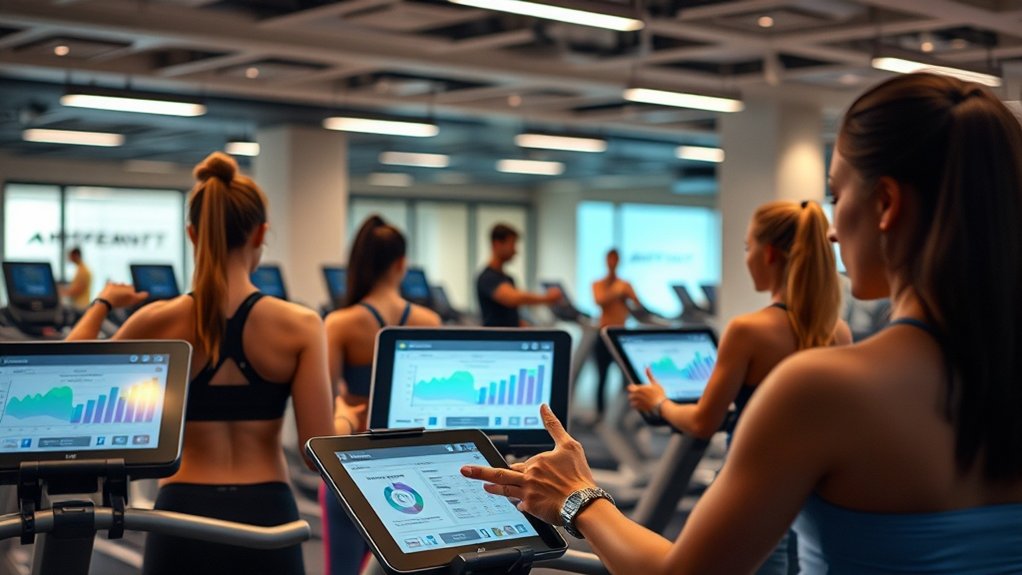
While traditional workout programs once followed a one-size-fits-all methodology, 2025’s personalized workout plans employ sophisticated algorithmic frameworks that synthesize multifactorial client data—including thorough fitness assessments, movement screening protocols, and goal-specific parameters—to generate individualized programming.
This workout customization uses fitness technology to analyze your equipment inventory, training history, and performance metrics in real-time. You’ll receive programming that integrates multiple modalities: resistance training, cardiovascular conditioning, and mobility work, creating balanced physiological adaptations.
AI-driven platforms continuously adjust training variables—volume, intensity, and exercise selection—based on your biometric feedback and recovery indicators. Certified trainers conduct periodic evaluations, recalibrating your protocol as you progress.
Most platforms offer trial periods, with subscription costs averaging $34 monthly, making sure accessibility to evidence-based, personalized fitness programming.
Key Features That Define Quality Personalized Programming
Understanding how workout plans are structured provides the foundation for evaluating what separates premium services from basic alternatives. Quality program customization extends beyond generic templates—you’ll find evidence-based services assess your training experience, specific goals, and equipment accessibility before designing protocols.
Leading platforms like The Shred App and Caliber employ certified coaches who conduct regular check-ins, optimizing client engagement through accountability measures and data-driven adjustments. Essential technical features include thorough exercise libraries with form-focused instructional videos, making sure safe movement execution.
Progress tracking systems provide quantifiable metrics—strength gains, body composition changes, performance benchmarks—that inform programming modifications. Premium services integrate nutrition guidance protocols, recognizing that training adaptations require adequate fueling strategies.
These evidence-based components collectively define professional-grade personalized programming that delivers measurable outcomes.
Service Models: Self-Paced, Adaptive AI, Hybrid Coaching, and Fully Managed Options
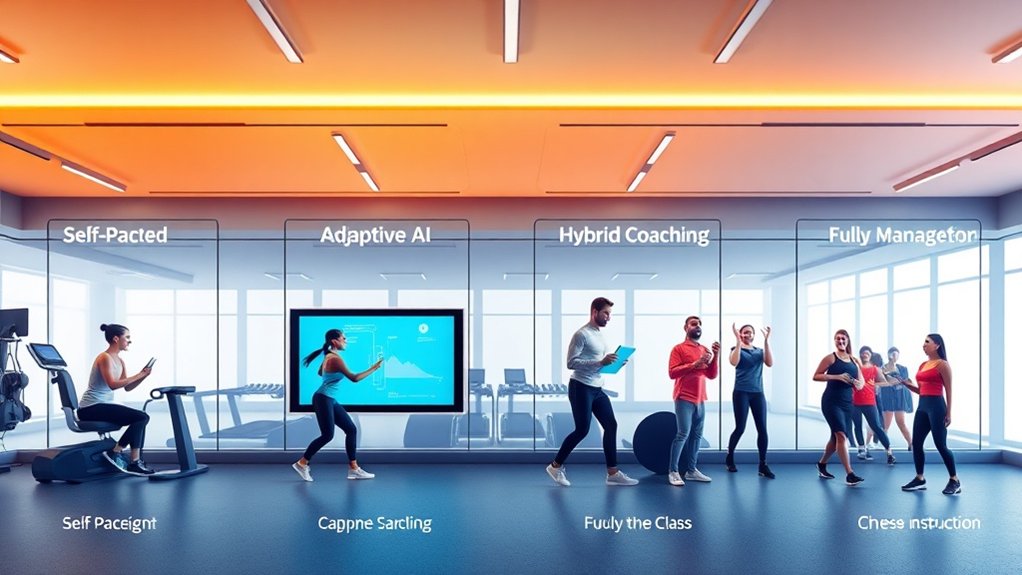
When evaluating personalized workout plan services, you’ll encounter four distinct service models that differ considerably in their delivery mechanisms and degree of human interaction.
Each model—self-paced programs, adaptive AI systems, hybrid coaching arrangements, and fully managed one-on-one services—offers specific advantages aligned with different training objectives, accountability requirements, and budget constraints.
Understanding these architectural differences enables you to select a service model that best supports your physiological adaptations, adherence patterns, and long-term programming needs.
Four Core Service Models
The personalized workout plan industry has consolidated around four distinct service delivery models, each engineered to address specific training requirements and user engagement preferences.
Self-paced platforms like Nike Training Club maximize service flexibility through extensive workout libraries accessible at no cost.
Adaptive AI systems, exemplified by JuggernautAI, employ machine learning algorithms to modify programming based on performance metrics and subjective feedback.
Hybrid coaching models such as Future integrate certified personal trainers with app-based tracking infrastructure at approximately $199 monthly.
Fully managed services like Caliber deliver thorough programming with continuous coach communication through multiple channels.
This tiered approach accommodates varying investment levels—from free entry points to premium $200 monthly subscriptions—while addressing distinct user engagement patterns and training sophistication requirements across the fitness spectrum.
Matching Model to Goals
Selecting ideal service architecture requires systematic evaluation of three primary variables: training objectives, behavioral patterns, and performance measurement preferences.
You’ll achieve optimal goal alignment when matching service models to specific outcomes: self-paced platforms suit maintenance-phase athletes with established routines, while adaptive AI coaching serves progressive overload requirements through algorithm-driven periodization.
Hybrid models provide structured accountability for intermediate practitioners requiring periodic form assessment and program modifications. Fully managed options deliver extensive support for complex goals—sport-specific preparation, rehabilitation protocols, or body composition transformation requiring frequent biometric monitoring.
Your service selection should prioritize credential verification: certified strength and conditioning specialists (CSCS), registered dietitians (RD), or physical therapists (PT) depending on objectives.
Budget considerations directly correlate with personalization depth—self-paced services ($10-30 monthly) versus fully managed coaching ($200-500 monthly) reflecting expertise accessibility and real-time intervention capacity.
What to Expect at Different Price Points ($0–$200+ Per Month)
Budget allocation directly influences the caliber of personalized fitness programming you’ll receive, with distinct service tiers offering markedly different levels of customization, expert interaction, and evidence-based programming.
| Price Tier | Service Features |
|---|---|
| $0 | Pre-designed workout libraries (Nike Training Club, Boostcamp); limited personalization; self-directed programming |
| $12.99–$39 | Live/on-demand classes (Peloton); multi-modal training options; community-driven accountability |
| $19–$20 | Certified coaching (Caliber, BetterMe); customized programming; nutritional guidance; improved user experience |
| $199+ | One-on-one credentialed trainers (Future); biomechanically-optimized plans; extensive accountability protocols; pricing transparency |
Free platforms provide algorithmic recommendations without expert oversight. Mid-tier services ($19–$20/month) incorporate professional coaching credentials and individualized assessment. Premium options ($200+/month) deliver direct trainer communication, periodic program adjustments, and form analysis, justifying higher investment through measurable adherence improvements.
Matching Service Types to Your Fitness Level and Goals

Your fitness level and objectives directly determine which service architecture will optimize your training outcomes.
Beginners require foundational movement pattern instruction and progressive overload protocols, while advanced practitioners need periodized programming with sport-specific biomechanical considerations.
Evidence-based platforms like Future and Caliber employ certified trainers (NASM-CPT, CSCS) who conduct baseline assessments to prescribe goal-contingent interventions—whether hypertrophy-focused mesocycles for muscle gain or VO2 max development for endurance athletes.
Beginner Vs Advanced Features
When evaluating personalized workout plan services, you’ll find that the distinction between beginner and advanced features directly impacts training efficacy and adherence rates.
Beginner advantages include instructional video libraries, intuitive interfaces, and progressive overload protocols that build foundational movement patterns. Services like BetterMe and Nike Training Club prioritize educational content and gradual intensity scaling, reducing injury risk while establishing proper form mechanics.
Advanced flexibility manifests through AI-driven periodization in platforms like JuggernautAI and Fitbod, which use algorithmic adjustments based on performance metrics and recovery status.
Future’s personalized coaching model provides real-time programming modifications tailored to elite training objectives. These sophisticated systems accommodate complex periodization schemes, sport-specific conditioning protocols, and granular load management—essential features for experienced athletes requiring targeted physiological adaptations beyond basic fitness development.
Goal-Specific Program Selection
- Hypertrophy protocols: Caliber’s strength-focused coaching delivers periodized resistance training with progressive overload principles for muscle gain.
- Fat oxidation programs: Shred’s AI algorithms adjust metabolic conditioning based on adherence patterns and biometric feedback for weight loss.
- Cardiovascular adaptation: Future’s certified trainers design heart rate zone-specific programming for endurance development.
- General fitness maintenance: Nike Training Club provides adequate program variety through equipment-optional bodyweight circuits.
Services with narrow specialization excel within their scope, while platforms offering extensive programming accommodate evolving objectives.
Your current training age and physiological baseline should inform selection.
Evaluating Initial Assessments and Onboarding Quality
The caliber of initial assessments determines whether a personalized workout service can genuinely deliver evidence-based programming or merely repackages generic templates. Assessment accuracy requires thorough data collection—anthropometric measurements, movement screening protocols, and validated fitness questionnaires that establish baseline capabilities.
Services employing certified professionals (CSCS, NASM-CPT) demonstrate superior onboarding effectiveness through structured intake procedures and video-based movement analysis.
Onboarding quality separates premium platforms from basic offerings. You’ll find that services implementing regular check-ins during initial weeks maintain accountability while adjusting programming variables based on your adaptation responses.
Platforms providing detailed feature tutorials and progressive goal-setting frameworks show measurably higher retention rates. The integration of feedback loops during onboarding guarantees your training prescription evolves with physiological adaptations rather than following static templates.
Progress Tracking, Feedback Loops, and Plan Adaptation
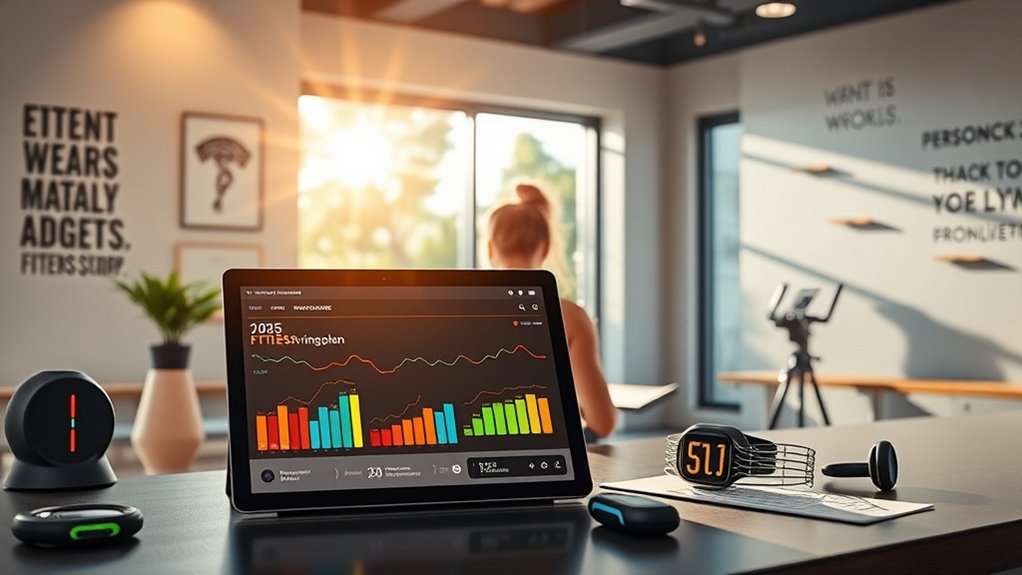
Your workout service’s capacity for real-time performance monitoring directly correlates with adherence rates and outcome optimization.
Evidence-based platforms use biometric data integration and exercise velocity tracking to generate actionable insights, while AI-driven workout adjustments employ machine learning algorithms that modify training variables—volume, intensity, and frequency—based on your recovery metrics and performance trends.
Certified trainers and validated AI systems should demonstrate their ability to implement progressive overload protocols that respond to your physiological adaptations within 24-48 hours of data collection.
Real-Time Performance Monitoring
When evaluating personalized workout plan services, real-time performance monitoring stands as a critical differentiator that separates basic exercise apps from extensive fitness platforms. These systems integrate performance analytics to deliver actionable insights during your training sessions.
Leading services provide:
- Biometric tracking – Heart rate, workout duration, and caloric expenditure monitoring through wearable device integration
- Immediate feedback loops – Instant analysis of your technique and intensity levels to optimize each repetition
- Trainer-guided adjustments – Platforms like Future and Caliber connect you with credentialed coaches who interpret your data and provide real-time adjustments
- Adaptive algorithms – Sophisticated systems that modify workout intensity and focus based on your demonstrated performance patterns
Apps such as Nike Training Club and Juggernaut AI use these tracking capabilities to prevent training plateaus while maintaining progressive overload principles.
AI-Driven Workout Adjustments
Real-time monitoring capabilities provide the raw data infrastructure, but artificial intelligence transforms this information stream into dynamic programming modifications that respond to your physiological adaptations.
Platforms like JuggernautAI and Future demonstrate superior AI responsiveness through algorithmic analysis of your activity patterns, automatically adjusting exercise intensity, volume, and modality to prevent training plateaus.
These feedback loops process performance metrics to identify improvement opportunities and recalibrate programming accordingly. The continuous adaptation mechanism improves user engagement by establishing accountability structures—you’ll observe measurable progress resulting from these intelligent modifications.
This evidence-based approach guarantees your training stimulus remains ideally challenging as your fitness capacity evolves, eliminating the need for manual program redesign while maintaining progressive overload principles that drive physiological adaptation.
Support Channels: App Messaging, Check-Ins, and Direct Coach Access
How effectively can you connect with your coach when questions arise mid-workout or motivation wanes? Support channels directly impact your training outcomes and adherence rates.
Evidence demonstrates that multi-channel communication systems improve user engagement metrics considerably.
Modern platforms integrate extensive support infrastructure:
- App messaging enables asynchronous communication for technique clarification and program modifications.
- Scheduled check-ins provide structured accountability touchpoints, correlating with improved completion rates.
- Direct coach access through video consultations allows real-time form analysis and biomechanical corrections.
- Coach feedback response times typically range from 2-24 hours, depending on service tier.
Services like Future exemplify dedicated coaching models, assigning certified professionals who maintain consistent communication throughout your training cycle.
This credential-focused approach guarantees qualified oversight of your progression and technical development.
Integration With Wearables, Nutrition Tools, and Health Apps

Modern fitness ecosystems require logical data synchronization across multiple platforms to maximize training effectiveness and adherence. Wearable compatibility with devices like Apple Watch enables services such as Future and Nike Training Club to capture real-time biometric data, facilitating dynamic workout adjustments based on performance and recovery metrics.
This integration extends to consolidated health platforms including Apple Health and Google Fit, allowing you to centralize your fitness data across applications.
Nutrition tracking capabilities distinguish thorough services from exercise-only platforms. Applications like Shred App and Caliber incorporate meal logging and caloric monitoring tools, creating a holistic health management system.
Services like Future exemplify this integrated approach by combining workout analytics with nutrition insights, enabling evidence-based program modifications. The technical infrastructure supporting these integrations guarantees peak training efficacy through data-driven personalization and adaptive programming methodologies.
Trust Signals: Evidence-Based Programming, Credentials, and User Outcomes
When evaluating personalized workout services, you’ll find that verifiable trainer credentials serve as the primary indicator of program legitimacy and safety. Certifications from NASM, ACE, and similar organizations validate expertise in exercise science and program design.
Evidence-based programming distinguishes effective services through:
- Research-backed methodologies that incorporate current fitness science and proven training protocols
- Progress tracking systems that quantify strength gains, endurance improvements, and body composition changes
- Adaptive programming algorithms that modify workouts based on your performance data and recovery metrics
- Outcome documentation demonstrating measurable client results across diverse populations
These trust signals directly impact user engagement and client retention rates. Services that prioritize credentialed trainers and evidence-based approaches consistently show superior adherence rates, with clients reporting improved motivation through accountability features and tangible progress measurements.
Frequently Asked Questions
What Is the Best Personalized Workout App?
Finding your perfect fitness companion isn’t one-size-fits-all. You’ll want Shred App (4.28/5) for AI-driven fitness goals, or Nike Training Club’s extensive app features at zero cost. Caliber excels in strength training with evidence-based programming rated 4.6-4.7/5.
What Is the 2 2 2 Rule in Gym?
The 2-2-2 rule is a gym technique where you’ll perform two sets of two different exercises targeting one muscle group. This fitness principle optimizes training efficiency by combining compound and isolation movements for improved muscle stimulation and growth.
What Is the Best Workout Subscription?
You’ll find Nike Training Club offers the best value, providing extensive workout variety at zero cost. For fitness motivation through personalized coaching, Shred App’s AI-driven plans at $9.99 monthly deliver evidence-based programming at 70% below industry average pricing.
What Is the 3-3-3 Rule in Gym?
You’ll uncover the 3-3-3 rule among essential fitness principles: perform three sets of three exercises with three reps each, targeting one muscle group. This effective training method maximizes strength gains through high-intensity lifting for advanced athletes.