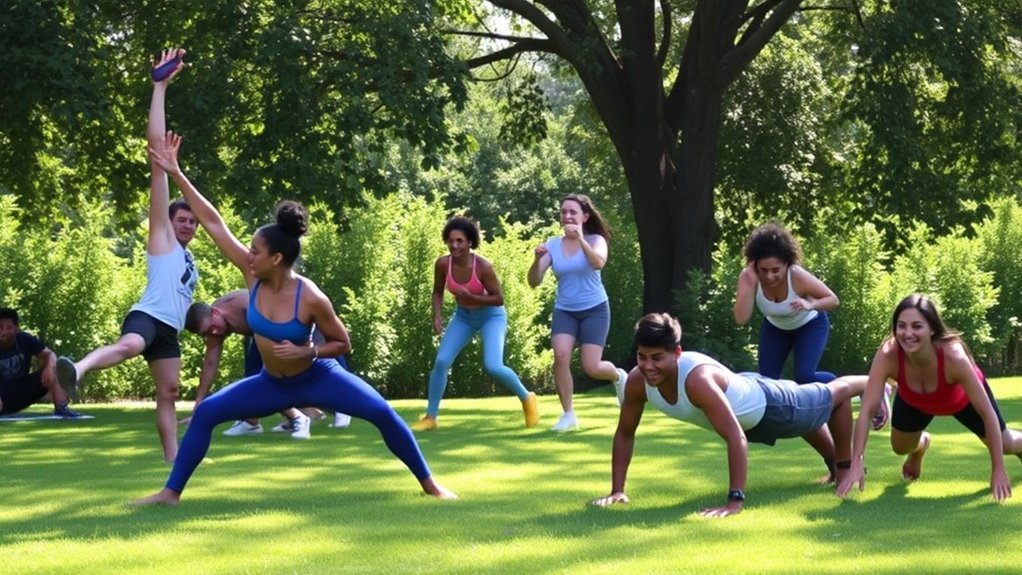
You’ll build strength effectively with bodyweight training by mastering progressive variations of fundamental movements. Start with basic push-ups, squats, and planks, then advance by manipulating tempo (slow 3-second negatives increase time under tension), adjusting dynamics (progress from regular to archer push-ups), or adding explosive elements. Track your reps consistently—once you’re hitting 15-20 with perfect form, it’s time to increase difficulty through positioning changes or harder variations. This systematic approach creates the mechanical tension necessary for muscle growth, and understanding proper progression sequences will help you maximize results without equipment.
Understanding Bodyweight Training Progressions: From Beginner to Advanced Movements
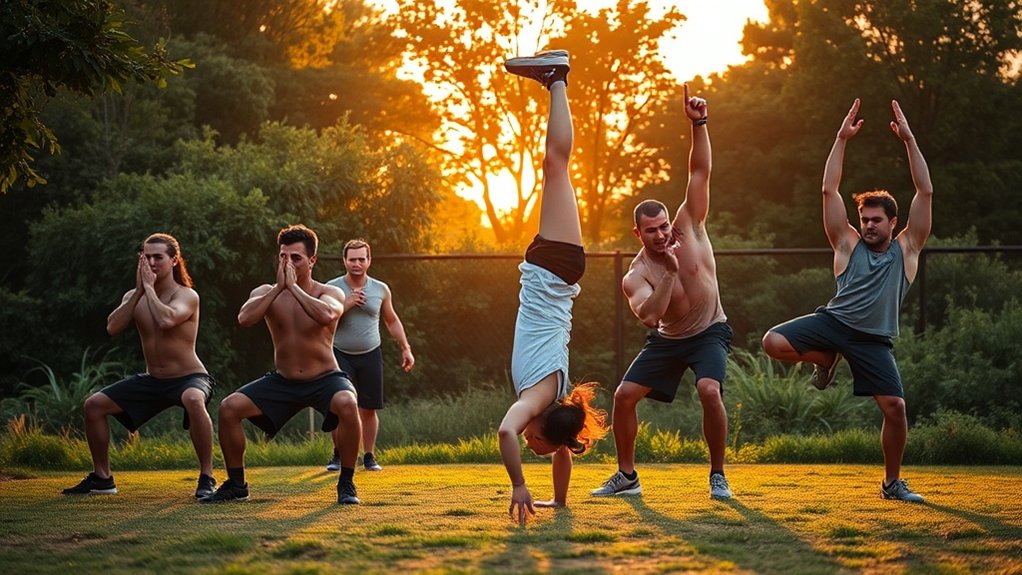
Because bodyweight training builds strength through systematic progression rather than external load, understanding how to advance from foundational to complex movements determines your long-term success.
Your bodyweight workout routine should begin with foundational exercises like squats and push-ups, guaranteeing proper form before attempting advanced movements such as pistol squats or one-arm push-ups.
You’ll build strength by manipulating key variables: increasing repetitions, extending hold durations, or adding explosive elements like jump squats.
Incorporating unilateral exercises—single-leg deadlifts, for instance—challenges your balance and stability while developing thorough strength.
Track your progress consistently by recording small improvements: one additional rep, reduced rest intervals, or cleaner execution.
This systematic approach to bodyweight training progressions maintains motivation and guarantees continuous adaptation, transforming basic movements into athletic mastery over time.
Mastering Push-Up and Pull-Up Progressions Without Equipment
Since push-ups and pull-ups form the foundation of upper body strength training, mastering their progressions opens up thorough muscle development across your chest, shoulders, back, and arms.
Begin your bodyweight journey by performing wall or knee push-ups, establishing proper push-up position before advancing to standard variations. Progress through incline, decline, and archer push-ups as your fitness level improves.
For pull-ups, start with band-assisted variations or use a sturdy surface for support. Negative pull-ups—lowering slowly from the top position—build essential strength for full repetitions.
These workout routines target different muscle groups while increasing stability.
Consistent practice with proper form accelerates your upper body development. Each progression challenges your muscles differently, assuring continuous strength gains without requiring equipment.
Squat and Lunge Variations: Building Lower Body Strength Through Influence
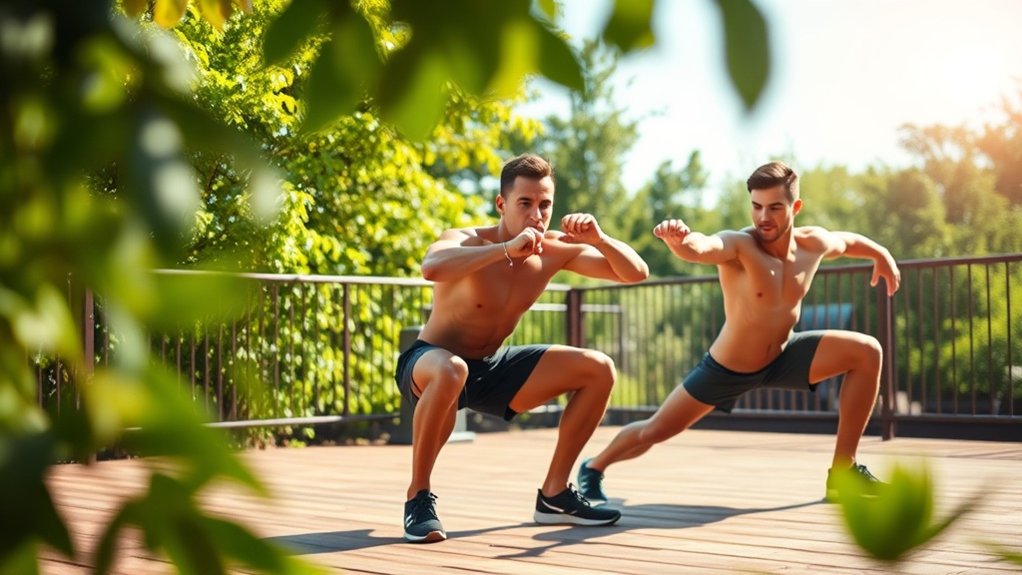
You’ll maximize lower body development by systematically progressing through advantage-based squat and lunge variations that shift your center of gravity and alter mechanical benefit.
Progressive squat techniques—from box squats to pistol squats—increase resistance by reducing your base of support and demanding greater stabilization from your working muscles.
Advanced lunge patterns incorporate directional changes, raised positions, and tempo manipulation to target different muscle fibers while challenging your balance and coordination under varying load angles.
Progressive Squat Influence Techniques
When you shift your body’s center of gravity during squats and lunges, you fundamentally change which muscles bear the load and how intensely they work.
Progressive squat utilization techniques form the foundation of any effective bodyweight training program, allowing you to build muscle without equipment by manipulating angles and body positioning.
Master proper squat form first—feet shoulder-width apart, chest up, knees tracking over toes.
Once you’ve established this baseline, you can advance to challenging squat variations like sumo squats, which target your inner thighs and glutes through wider stance mechanics.
Single-leg squats increase difficulty dramatically by concentrating your entire body weight on one lower body limb.
Progress your lunges from stationary to walking and reverse variations, improving balance while strengthening quadriceps, hamstrings, and glutes systematically.
Advanced Lunge Movement Patterns
Advanced lunge patterns transform basic forward lunges into thorough strength-building movements that challenge your lower body through multiple planes of motion.
You’ll target your glutes, quadriceps, and hamstrings more effectively through advanced lunge variations like jumping lunges and reverse lunges. Adding rotation engages your core muscles while improving balance and coordination.
Lateral lunges develop your adductors and improve sideways mobility essential for athletic performance.
Single-leg lunges, particularly Bulgarian split squats, demand greater stabilizer engagement and produce superior muscle activation compared to bilateral movements.
You can apply progressive overload by increasing repetitions or incorporating explosive movements to accelerate strength gains.
These bodyweight workouts systematically build lower body strength without equipment while preparing you for more complex athletic demands through functional movement patterns that translate directly to real-world performance.
Core Strengthening Exercises Using Only Your Bodyweight
Building a strong core requires nothing more than your body and proper form. Bodyweight exercises like planks, mountain climbers, and hollow holds engage multiple muscle groups simultaneously, developing stability and strength for your entire midsection.
Start with planks, holding for 45 seconds to 1 minute while maintaining proper alignment from head to heels. This foundational exercise targets your abdominals, obliques, and lower back.
Mountain climbers add cardiovascular intensity to your workout at home—perform 20-second intervals followed by 10-second rest periods for ideal full body engagement.
Progress your core training by incorporating bird dogs for improved balance and coordination, completing 3 sets of 8 to 10 reps.
Advanced practitioners can combine dragon flags with flutter kicks, performing 3 sets to maximize muscular engagement and core development.
Creating Progressive Overload Through Tempo, Positioning, and Plyometrics
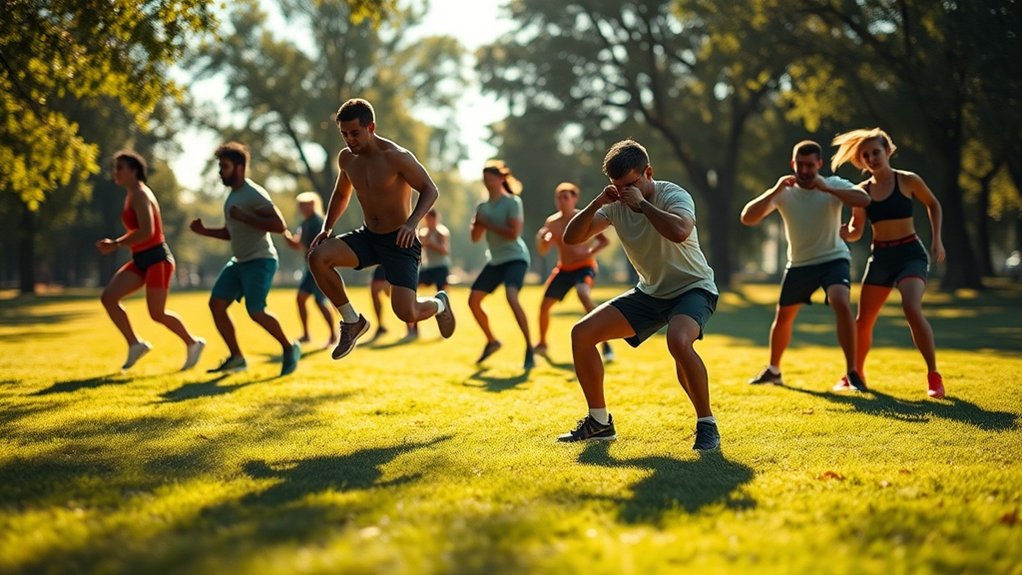
Since traditional weightlifting relies on adding plates to build strength, you’ll need alternative methods to challenge your muscles with bodyweight training.
Progressive overload through tempo manipulation proves highly effective—slow your eccentric phase to increase time under tension and improve muscle growth. You can also adjust positioning to intensify bodyweight moves: raise your feet during push-ups or progress to single-leg squats. These variations engage different muscle groups while maintaining proper form.
Plyometrics add another dimension by incorporating explosive movements like jump squats and clap push-ups, developing power through rapid muscle contractions.
Track your progression by consistently increasing repetitions, hold durations, or adjusting rest periods. Monitor these variables systematically to guarantee continuous adaptation and strength gains throughout your bodyweight program.
Complete Bodyweight Program Templates for Strength and Muscle Development
When structuring a complete bodyweight program, you’ll organize your workouts around push, pull, and leg movements distributed across 3-4 training days per week.
Each training session begins with a structured warm-up targeting mobility and muscle activation, followed by 3-5 compound exercises performed in circuits. You’ll complete 2-4 rounds with minimal rest between movements to maximize strength development and fitness gains.
Your routine should incorporate progression strategies: increase repetitions weekly, adjust tempo to 3-1-3 cadence, or advance to harder exercise variations.
Include modifications for different fitness levels—beginners perform standard push-ups while advanced trainees progress to archer or one-arm variations.
Schedule your workout by alternating upper and lower body days, making sure adequate recovery between sessions.
End each training day with targeted stretching to improve flexibility and support muscle recovery.
Bodyweight Training Vs Weighted Resistance: When to Progress Beyond Calisthenics

You’ll know it’s time to add weighted resistance when you can perform 15-20 reps of an exercise with perfect form but feel minimal muscular fatigue.
This plateau signals your muscles have adapted to your bodyweight, requiring progressive overload through external load to stimulate further strength gains.
Strategic weight addition—starting with 5-10% of your bodyweight for upper body movements and 10-20% for lower body exercises—allows you to drop back into the hypertrophic rep range of 8-12 while maintaining proper technique.
Strength Plateau Indicators
The moment your bodyweight routine stops producing results marks a vital juncture in your training journey. Recognizing a strength plateau requires monitoring specific performance metrics throughout your bodyweight training.
If you’re completing the same number of repetitions across multiple sessions without progression, you’ve likely plateaued. Another clear indicator is the absence of muscle soreness following workouts that previously challenged you.
When exercises feel effortless at maximum reps, your muscles aren’t receiving adequate stimulus for adaptation. Track your sets, repetitions, and workout intensity consistently to identify stagnation patterns.
Diminished training motivation often accompanies plateaus, signaling your body’s readiness for increased challenge. These signs indicate one vital reality: it’s time to implement advanced progressions or weighted resistance to continue building strength effectively.
Adding Weight Strategically
Once you’re consistently hitting 15 or more reps in fundamental movements like push-ups, squats, and rows, your muscles won’t adapt without additional resistance.
Research confirms that weighted resistance improves hypertrophy beyond bodyweight training alone. Start with a weighted vest during sets of 10 pushups, confirming your body can form a straight line from head to heels.
For squats, add ankle weights while keeping your elbows forward and squeeze your glutes at the top—never let your lower back round or lower your hips too quickly.
Progress to single-leg variations before adding weight, as one leg exercises demand superior stability.
Track your weights, reps, and sets meticulously. Increase load gradually to maintain proper form and prevent injury while consistently challenging your musculature.
Frequently Asked Questions
How Many Times per Week Should I Do Bodyweight Workouts?
You’ll achieve ideal results training 3-4 times weekly, following frequency guidelines that balance workout duration with recovery days. Your schedule flexibility accommodates individual goals, while training intensity and program variations guarantee progression-oriented adaptations without overtraining.
Can Bodyweight Training Help With Weight Loss and Fat Burning?
Yes, you’ll burn fat through bodyweight training by creating a caloric deficit, boosting metabolic rate, and preserving muscle. Higher exercise intensity improves fat oxidation, while workout consistency and hormonal balance optimize your results when proper form and progression are maintained.
What Should I Eat to Support My Bodyweight Training Program?
Focus on lean protein sources after training for recovery, time carb intake around workouts, maintain proper hydration throughout the day, prep healthy snacks in advance, and prioritize post-workout nutrition to support your progress and performance goals.
How Long Should Rest Periods Be Between Bodyweight Exercises?
You’ll need 30-90 seconds between exercises, depending on your workout intensity balance and individual fitness levels. Rest duration techniques should align with your personal fitness goals—shorter for exercise circuit flow, longer when recovery importance and progression-oriented training matter most.
Can Bodyweight Workouts Build Muscle as Effectively as Gym Training?
Yes, you’ll access comparable muscle growth through strategic bodyweight training. Your success hinges on progressive overload, workout intensity, exercise variation, and training frequency. Prioritize metabolic adaptation and recovery strategies while maintaining proper form for best results.