
Your custom cable machine workout plan should use constant tension throughout each rep’s full range of motion, which optimizes muscle fiber recruitment and hypertrophy more effectively than free weights’ variable resistance curves. You’ll want to program 8-12 reps per set with 30-90 seconds rest, incorporating both bilateral exercises like seated rows and unilateral movements to address strength imbalances. Progressive overload through weekly resistance increases, combined with strategic pulley angle adjustments and diverse attachment selections, maximizes your muscle development while minimizing joint stress. The thorough approach below outlines specific exercise selections, advanced intensity techniques, and periodized programming templates.
Understanding Constant Tension Training and Cable Machine Benefits
When you train with cable machines, you maintain consistent resistance from the starting position through the complete range of motion—a mechanical advantage that free weights can’t replicate due to gravitational force vectors.
This constant tension training optimizes muscle activation throughout each repetition, directly supporting hypertrophy and strength development.
You’ll experience reduced injury risk since cables minimize joint stress through controlled resistance pathways.
Cable machines offer versatile exercise variations, allowing precise targeting of specific muscle groups while you adjust resistance levels instantly. This adaptability proves particularly valuable for customizing intensity based on your current capacity.
The sustained tension enables superior muscle isolation, eliminating momentum-based cheating.
You’ll achieve efficient workouts through shorter rest intervals and superset capabilities, maximizing training density without compromising safety or technical precision.
Essential Cable Exercises by Muscle Group: Complete Exercise Library
Cable training’s proven benefits require strategic exercise selection matched to your specific muscle groups and training objectives. The constant tension provided by adjustable resistance guarantees peak muscle activation throughout the full range of motion when targeting specific muscle groups.
Core Exercise Categories for Complete Development:
- Back muscles: Seated Cable Rows and Lat Pulldowns establish foundational pulling strength while maintaining continuous tension.
- Chest muscles: Cable Flyes and Cable Chest Presses deliver controlled resistance across multiple pressing angles.
- Arms: Cable Bicep Curls and Tricep Pushdowns isolate upper extremities with precise force application.
Additional movements include Cable Squats, Cable Kickbacks for lower body, and Cable Crunches with Pallof Presses for core stability.
Proper technique remains essential for preventing injury—maintain core engagement and control movement speed throughout each repetition.
Cable Attachment Variations and Pulley Angle Adjustments for Optimal Muscle Activation
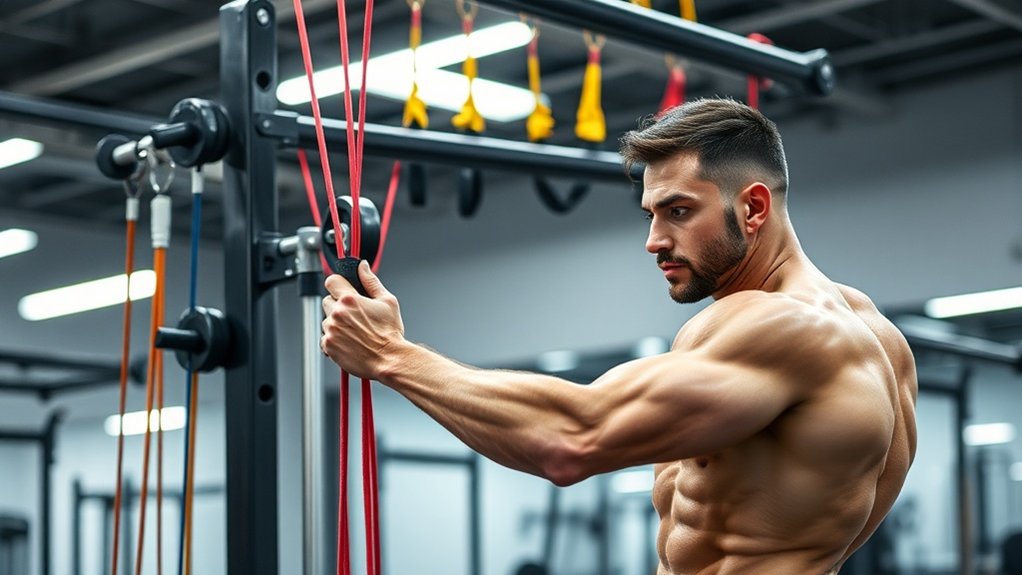
Because resistance vectors directly determine which muscle fibers receive maximum mechanical tension, selecting appropriate cable attachments and pulley positions becomes critical for achieving your targeted muscle activation patterns.
Cable attachment variations like D-handles, ropes, and straight bars enable precise muscle engagement through modified grip positions. You’ll improve constant tension training by adjusting pulley angle adjustments: high positions activate upper back and shoulders, while low angles emphasize glutes and lower back.
For peak muscle activation during cable flyes and lateral raises, manipulate pulley height to accommodate unique body types and maximize recruitment. Rope attachments improve tricep activation by supporting natural wrist positioning.
Systematically rotating attachments and angles prevents adaptation plateaus, making certain continuous muscle growth through consistent mechanical tension across complete movement ranges.
Cable Training for Hypertrophy: Programming for Maximum Muscle Growth
Since hypertrophy requires specific mechanical and metabolic stimuli, you’ll structure your cable training around three fundamental principles: progressive tension overload, time under tension, and metabolic stress accumulation.
Your workout programs should implement these evidence-based protocols:
- Rep Range Optimization: Target 8-12 repetitions per set, as research consistently demonstrates this range maximizes muscle growth while maintaining constant tension throughout each movement.
- Strategic Rest Intervals: Limit rest periods to 30-90 seconds between sets to amplify metabolic stress, which drives hypertrophy adaptations alongside mechanical tension.
- Systematic Progression: Increase cable resistance incrementally every 1-2 weeks to guarantee progressive overload continues stimulating muscle protein synthesis.
Include diverse exercises targeting all major muscle groups—cable flyes, rows, curls, and pressdowns—to achieve balanced development.
This variety prevents adaptation plateaus while maintaining the continuous tension that makes cable training superior for hypertrophy.
Unilateral Cable Exercises for Balanced Strength and Muscle Development

You’ll maximize muscle balance and minimize strength asymmetries by incorporating single-arm cable rows into your hypertrophy program, as unilateral movements force each side to work independently without compensation from the dominant limb.
The single-arm row technique requires you to maintain a stable, square stance with your non-working hand anchored to the cable machine frame, engaging your core throughout the movement to prevent torso rotation.
This exercise pattern addresses common postural imbalances while allowing you to adjust resistance and cable height specifically for ideal scapular retraction and lat engagement on each side.
Single-Arm Row Technique
Master the Single-Arm Cable Row to address muscular imbalances that frequently develop from bilateral training patterns. This unilateral movement targets back muscles while demanding significant core engagement to resist rotational forces throughout the exercise.
Execution Protocol:
- Setup and Grip: Position yourself laterally to the cable machine, grasp the handle with your working arm, and establish a stable stance that allows controlled movement without compensating through torso rotation.
- Movement Mechanics: Pull toward your waist while keeping your elbow close to your body, maintaining constant tension on the target musculature through the complete range of motion.
- Angle Optimization: Adjust pulley height strategically to emphasize different back muscle fibers—higher positions target upper lats, while lower settings engage mid-back musculature for extensive muscle development and improved muscle activation.
Unilateral Movement Benefits
Training one limb independently through cable exercises creates measurable strength adaptations that bilateral movements can’t replicate. Unilateral cable exercises facilitate balanced strength development by exposing and correcting muscle imbalances that compromise performance and safety.
You’ll activate more muscle fibers during single-limb training, optimizing both strength gains and muscle hypertrophy compared to bilateral alternatives.
These movements demand improved core stability and proprioception as your body maintains equilibrium against asymmetric loads. This neurological challenge translates directly to injury prevention through improved movement patterns and functional strength.
The cable system’s adjustable resistance enables tailored resistance adjustments matching your individual strength levels, making certain effective training progression.
Cable Machines Vs Free Weights: Muscle Activation and Performance Comparison
How do cable machines stack up against free weights regarding muscle activation and overall performance? Research demonstrates that cable machines deliver distinct advantages through constant tension mechanics.
You’ll experience continuous muscle engagement throughout every rep, unlike free weights that create variable resistance patterns.
Key Performance Differences:
- Improved Muscle Activation – Cables generate greater activation in targeted muscle groups through consistent resistance, especially for smaller stabilizers.
- Reduced Injury Risk – The guided motion considerably decreases joint stress compared to free weight exercises, making training safer for your connective tissues.
- Superior Accessibility – Cable machines provide stability that’s beginner-friendly, allowing you to master proper form before progressing to more demanding movements.
This combination of targeted training precision and built-in safety mechanisms makes cables exceptionally effective for systematic muscle development.
Advanced Cable-Specific Intensity Techniques and Training Methods

You’ll maximize cable machine training efficiency by implementing advanced intensity techniques that exploit the constant tension advantage cables provide over free weights.
Drop sets allow immediate load reduction without reracking weights, while supersets between antagonistic muscle groups maintain continuous tension throughout extended work periods.
Incorporating isometric holds at peak contraction points and strategic pauses during the eccentric phase amplifies time under tension, increasing metabolic stress and mechanical tension—the primary drivers of hypertrophy.
Drop Sets and Supersets
When progressive overload through added weight or volume stalls, drop sets and supersets provide mechanically sound methods to intensify cable-based training without compromising form.
Cable machines excel for these techniques because you’ll adjust resistance quickly while maintaining constant tension throughout each set.
Implementing Drop Sets and Supersets Effectively:
- Drop Sets: Perform your exercise to muscular failure, reduce weight by 20-30%, then continue immediately for additional reps. This maximizes muscle fatigue and promotes hypertrophy through extended time under tension.
- Supersets: Pair opposing muscle groups (chest/back, biceps/triceps) back-to-back with minimal rest, boosting workout efficiency and training volume without excessive fatigue.
- Progression Protocol: Advanced lifters should implement these intensity techniques strategically—once weekly per muscle group—to break plateaus while preventing overtraining and maintaining proper strength training adaptations for muscular endurance development.
Isometric Holds and Pauses
Isometric holds and pauses transform standard cable movements into highly effective strength-building tools by extending time under tension at mechanically disadvantaged positions.
You’ll maximize muscle fiber recruitment by incorporating 3-5 second holds at peak contraction points during cable exercises—like holding the top position of a bicep curl where tension peaks.
Adding pauses during the eccentric phase further improves hypertrophy by forcing muscles to control resistance through the lengthening phase. This combination greatly increases your mind-muscle connection, allowing deliberate focus on targeted muscles throughout each repetition.
Research confirms these isometric holds boost both muscle endurance and strength gains beyond traditional repetitive movements.
Implement holds strategically during your final sets when pursuing maximum mechanical stress and metabolic fatigue for ideal adaptation.
Complete Cable Machine Workout Programs: Beginner to Advanced Templates
Cable machines provide systematic progression pathways that adapt to your current fitness level while maintaining precise resistance throughout each movement pattern.
Constant tension training optimizes muscle engagement across all experience levels through strategic exercise selection and controlled execution.
Progressive Program Templates:
- Beginner Foundation – Execute cable lat pulldowns, seated rows, and cable bicep curls for 8-12 reps using moderate resistance to establish upper body strength and proper movement mechanics.
- Intermediate Development – Incorporate cable chest flyes and tricep pushdowns with 10-15 reps, emphasizing progressive overload to stimulate muscle growth and improve endurance capacity.
- Advanced Integration – Implement high-intensity protocols combining cable woodchoppers and face pulls in supersets or tri-sets for 6-10 reps, targeting maximum strength gains through multi-planar movements.
Tailoring workout plans through resistance adjustments, grip variations, and angle modifications guarantees continuous adaptation and sustained progress.
Selecting the Right Cable Machine for Your Home Gym Setup
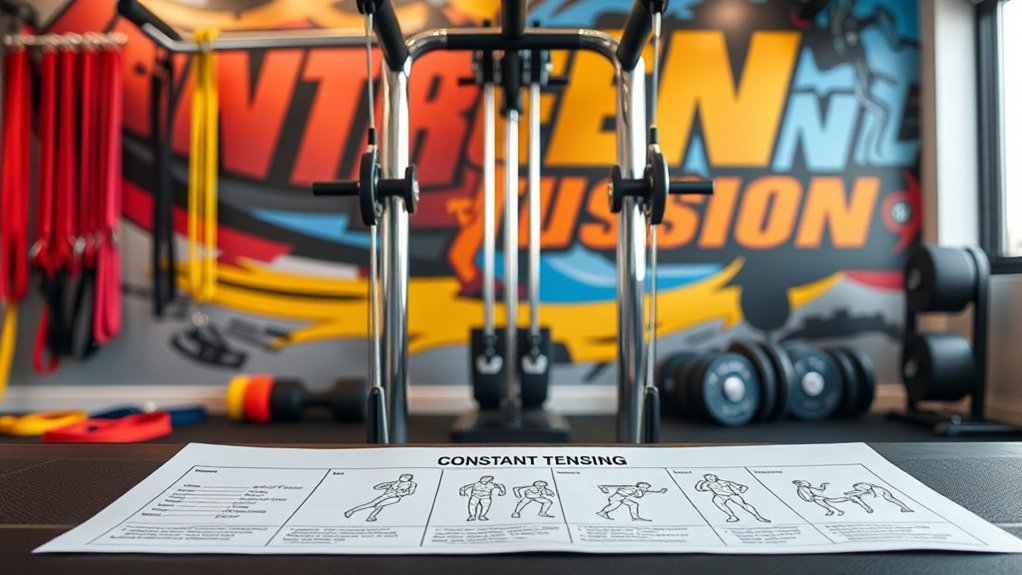
Optimizing your training program requires equipment that matches your specific performance objectives and spatial constraints.
You’ll need adjustable pulleys to perform effective exercise movements across different planes of motion, enabling you to target various muscle groups with proper biomechanics. Multiple attachment options expand your training versatility greatly.
Choose between weight stack systems for consistent progressive overload or resistance bands for variable tension profiles. A sturdy frame is non-negotiable—it guarantees stability during heavy pulling and pressing movements while preventing equipment failure.
Assess your space requirements carefully, measuring both footprint and clearance zones. Machines with compact design and multifunctional capabilities deliver maximum training variety per square foot, making them ideal for residential settings.
Prioritize build quality over price to guarantee long-term durability and safety during high-intensity training sessions.
Frequently Asked Questions
Can Cable Machine Training Help With Injury Rehabilitation and Recovery?
Yes, you’ll benefit from cable machines during rehabilitation through controlled muscle activation, augmented joint stability, and improved range of motion. They enable progressive overload while supporting injury prevention, functional movements, and flexibility improvement through evidence-based recovery protocols and safe strength training techniques.
How Often Should I Replace Cable Machine Attachments and Cables?
You should inspect cables monthly for wear indicators like fraying or stiffness, replacing them annually or when damaged. Check attachment compatibility and signs of damage quarterly. Quality replacements guarantee safety over cost-effective options, extending cable attachment lifespan through maintenance best practices.
What Safety Precautions Should I Take When Using Cable Machines?
You’ll guarantee cable machine safety by inspecting equipment before use, respecting weight limits, maintaining proper form, completing warm-up routines, following user guidelines, keeping personal space clear, knowing emergency stop locations, and prioritizing injury prevention through correct spotting techniques.
Can Cable Machines Help Improve Athletic Performance in Specific Sports?
Practice makes perfect—you’ll improve performance through sport-specific training using cable mechanics’ resistance versatility. Target muscles precisely, build explosive strength and endurance, improve agility drills, prevent injuries, and develop functional fitness that directly translates to your athletic goals.
How Do I Maintain and Clean My Cable Machine Properly?
You’ll need daily upkeep: wipe cables with approved cleaning solutions, inspect wear indicators, and follow your user manual’s maintenance schedule. Apply proper lubrication techniques monthly, guarantee rust prevention, and store equipment correctly to maximize longevity and safety.