Your personalized dumbbell workout plan should incorporate progressive overload principles through systematic exercise selection targeting all major muscle groups. You’ll need adjustable dumbbells ranging from 5-30 pounds, depending on your training experience. Execute 3-4 sets of 8-15 repetitions per exercise, focusing on controlled eccentric and concentric phases to maximize neuromuscular adaptation. Implement either three-day splits, full-body routines, or upper/lower divisions while tracking load progression and repetition volumes in a workout journal. The thorough framework below details specific exercise protocols, equipment recommendations, and evidence-based programming strategies for best home training results.
Understanding Personalized Dumbbell Training and Setting Your Goals
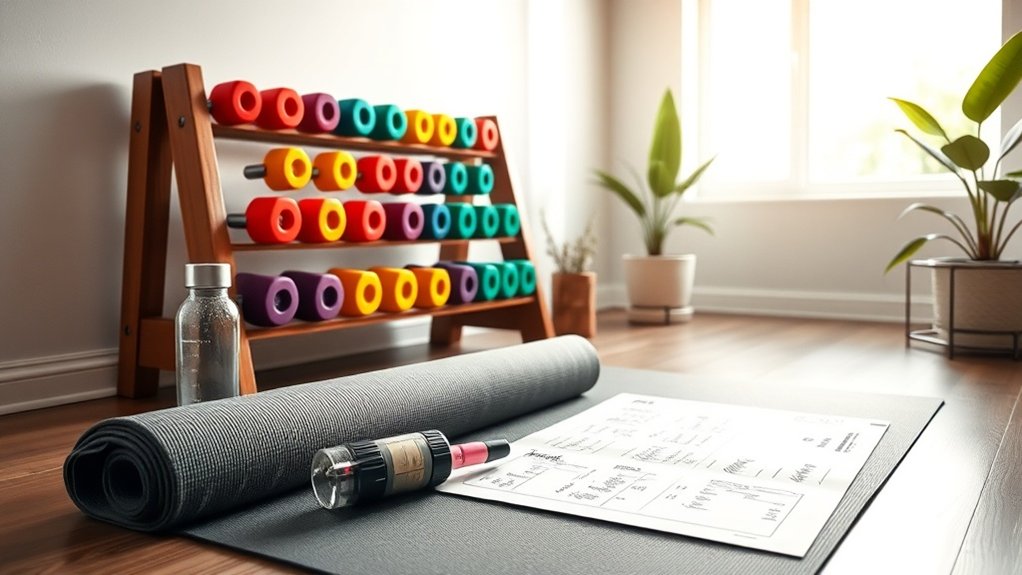
When you commence a dumbbell training program, establishing a structured framework through personalized planning optimizes neuromuscular adaptation and minimizes injury risk.
Personalized dumbbell training requires defining fitness goals through SMART criteria—whether targeting muscle gain, fat reduction, or functional strength improvement. Your workout plan must account for available time for exercise, assuring adherence without overtraining.
Effective workout routine design incorporates both compound and isolation exercises to facilitate balanced muscle engagement across all muscle groups.
Tracking progress through quantifiable metrics—load progression, repetition volumes, and rest intervals—enables data-driven modifications to your program.
This systematic approach to personalized dumbbell training establishes sustainable training patterns while maintaining proper exercise selection, intensity management, and recovery protocols essential for long-term muscular development and injury prevention.
Essential Dumbbell Equipment Selection and Weight Recommendations
Because proper equipment selection directly influences training efficacy and injury prevention, you must prioritize dumbbell specifications that align with your physiological capacity and progression requirements.
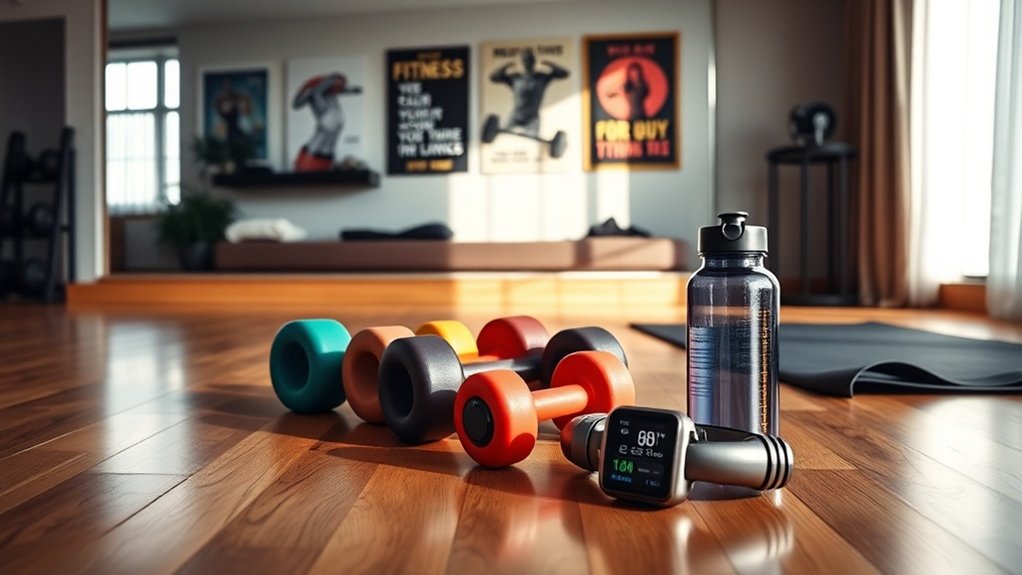
For your home gym, adjustable dumbbells offer space-saving advantages while accommodating diverse exercises. Weight recommendations vary by experience: beginner weights typically range 5-15 pounds, whereas intermediate lifters require 15-30 pounds depending on movement patterns. Advanced practitioners need 30+ pounds for compound exercises targeting larger muscle groups.
Selectorized dumbbells with dial or pin mechanisms optimize workout efficiency by minimizing shift time between sets. Establish a progressive range—5, 10, 15, and 20 pounds—to guarantee systematic adaptation and strength development.
This equipment configuration supports proper biomechanics while reducing injury risk through appropriate load selection matched to your current capabilities and training objectives.
Complete Dumbbell Exercise Library for All Major Muscle Groups
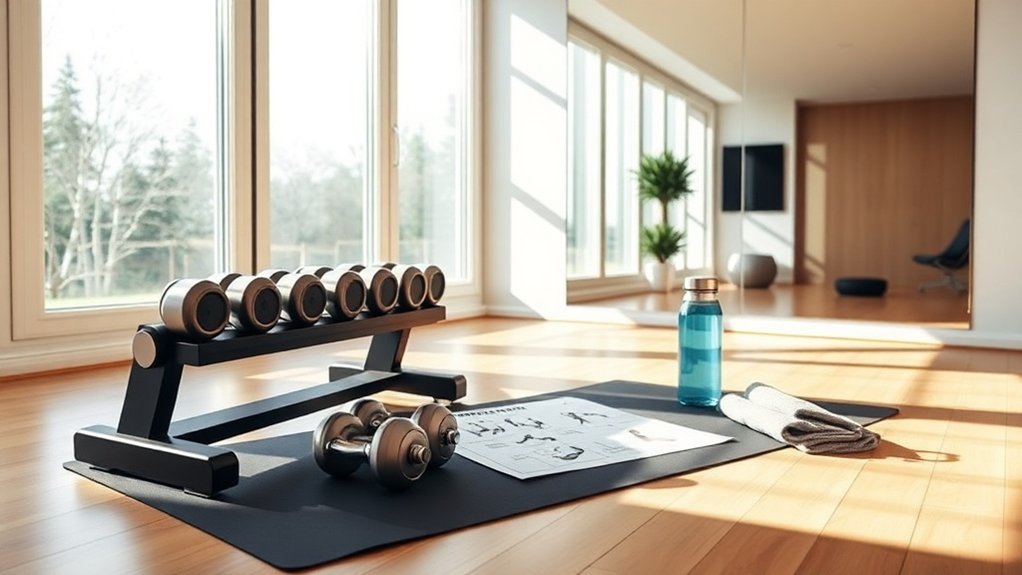
Mastery of fundamental dumbbell movements requires thorough knowledge of exercise mechanics across six primary muscle groups: chest, back, shoulders, legs, arms, and core. Your complete control during each repetition determines muscle activation quality and injury prevention effectiveness. Progressive overload through systematic weight increases drives hypertrophy and strength training adaptations in your home gym environment.
| Muscle Groups | Compound Exercises |
|---|---|
| Chest | Flat Dumbbell Press |
| Back | Dumbbell Rows |
| Shoulders | Overhead Press |
| Legs | Dumbbell Squats |
| Arms | Bicep Curls |
Execute 3-4 sets of 8-15 repetitions per exercise, maintaining proper form throughout each movement pattern. This evidence-based approach guarantees balanced muscular development while minimizing injury risk. Implement controlled eccentric and concentric phases for peak muscle fiber recruitment and sustainable strength gains.
Three Proven Dumbbell Training Splits for Home Workouts
Strategic implementation of training splits maximizes recovery capacity while maintaining sufficient training frequency for sustained muscle protein synthesis.
Your dumbbell workout plan should incorporate three proven approaches: a three-day split targeting chest/triceps, back/biceps, and legs for focused muscle growth; a full-body routine emphasizing compound movements three times weekly; or an upper/lower division alternating specific muscle groups.
Each session requires 4-5 exercises with 3-4 sets and reps ranging from 8-15, using progressive overload through incremental weight increases. You’ll achieve balanced muscle development by systematically challenging your musculature while allowing adequate recovery.
Begin every home workout with a thorough warm-up and cooldown protocol to improve performance and minimize injury risk. This structured approach guarantees ideal training stimulus across all major muscle groups.
Progressive Overload Strategies and Tracking Your Dumbbell Training Results
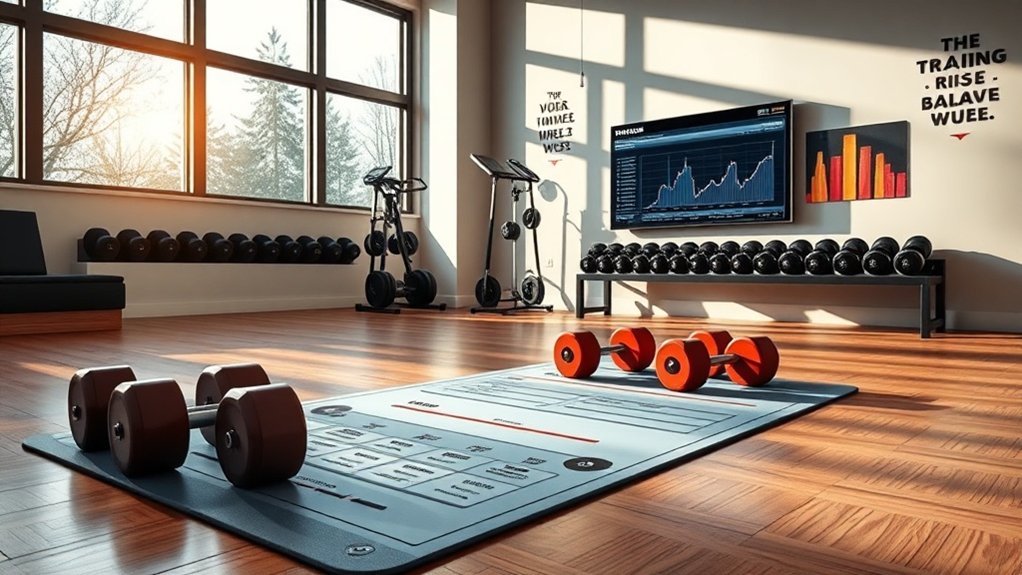
Your structured training split establishes the framework for muscle development, yet sustainable strength gains require systematic progression through quantifiable metrics.
Implement progressive overload by increasing weights used by 5-10% when you comfortably complete maximum reps completed in your prescribed range. Track your progress through a workout journal documenting weights, repetitions, and session duration. Review these entries weekly to identify strength improvements and adjust your training regimen accordingly.
Consider manipulating time under tension variables—specifically, decelerating the eccentric phase—to improve muscle growth without immediately adding load. This approach reduces injury risk while maintaining progressive stimulus.
Fitness apps refine data collection and trend analysis, enabling evidence-based programming modifications. Consistent monitoring guarantees your training remains appropriately challenging while respecting recovery capacity and biomechanical safety parameters essential for long-term adaptation.
Frequently Asked Questions
Can You Get a Complete Workout With Just Dumbbells?
You’ll reveal incredible dumbbell benefits through full body workouts that crush your fitness goals. Strength training with proper dumbbell techniques delivers workout variety, exercise efficiency, and serious muscle building. Home fitness resistance training can’t get more complete than this evidence-based approach.
What Is the 3-3-3 Rule in Gym?
The 3-3-3 rule involves performing three sets of three exercises targeting one muscle group, optimizing gym efficiency and workout variations. You’ll complete 8-12 reps per set with proper exercise techniques, supporting strength training and weight progression toward your fitness goals.
What Is the 3 2 1 Rule in Gym?
Like climbing a three-tiered mountain, you’ll perform three sets, two sets, then one set of different exercises. This 3-2-1 technique builds intensity progressively, delivers varied results, and guarantees safety through controlled reps while maintaining focus throughout your schedule.
What Is the 5 4 3 2 1 Workout Method?
You’ll perform exercises in a 5-4-3-2-1 breakdown, progressively decreasing sets while adjusting workout intensity levels. This method improves muscle engagement through exercise variations, supports fitness progression, offers schedule flexibility, and delivers overall effectiveness when aligned with your fitness goals and proper training frequency.