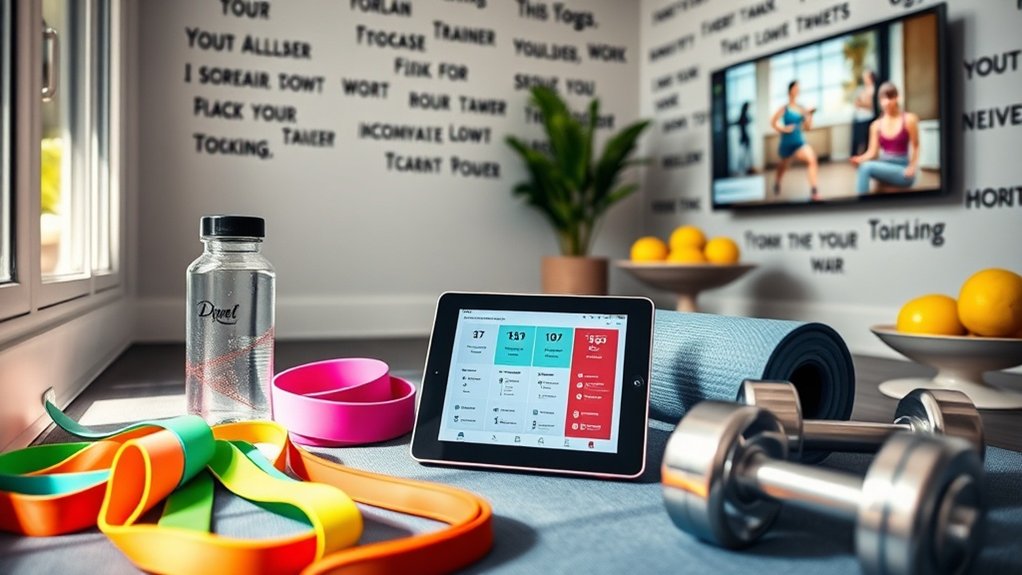

To create your personalized workout plan, you’ll need to define SMART fitness goals, document your complete training history and current fitness level through baseline assessments (cardiovascular endurance, muscular strength, body composition, flexibility), identify medical contraindications and movement restrictions, evaluate logistical factors like schedule and equipment access, and assess recovery variables including sleep quality, stress levels, and nutrition patterns. This thorough data collection establishes objective starting points, informs exercise selection, determines appropriate training intensities, and enables precise progress tracking throughout your fitness journey.
Essential Personal Inputs: Goals, History, and Current Fitness Level

When designing a personalized workout plan, you must first establish a thorough baseline of individual data that will inform every subsequent programming decision. Your fitness aspirations require definition through the SMART framework—making them Specific, Measurable, Achievable, Relevant, and Time-based. This structure transforms vague intentions into actionable targets.
You’ll need to document your complete fitness history, including previous training experiences, workout preferences, and any challenges you’ve encountered. This context establishes progression baselines and guides exercise selection.
Next, assess your current fitness level through body composition analysis, movement quality evaluation, and performance testing such as timed runs or pushup counts. These assessments create objective markers for tracking progress and determining appropriate training intensities that match your capabilities.
Medical and Physical Considerations: Injuries, Limitations, and Movement Quality
Beyond establishing your goals and fitness baseline, you must conduct a thorough medical screening to identify contraindications and movement restrictions that directly impact exercise selection and programming variables.
Your injury history reveals chronic conditions and past traumas requiring specific exercise modifications to prevent re-injury. Document joint limitations through movement assessment protocols that evaluate range of motion, stability, and pain patterns across functional movement patterns.
These assessments pinpoint biomechanical restrictions demanding adaptive programming strategies.
You’ll provide feedback on how exercises feel during initial sessions, enabling real-time adjustments to technique and load. This iterative process guarantees safety while maximizing training effectiveness.
Regular progress monitoring tracks evolving physical capabilities, allowing your program to adapt as movement quality improves and limitations resolve, maintaining alignment with your changing needs.
Practical Logistics: Schedule, Equipment Access, and Exercise Preferences
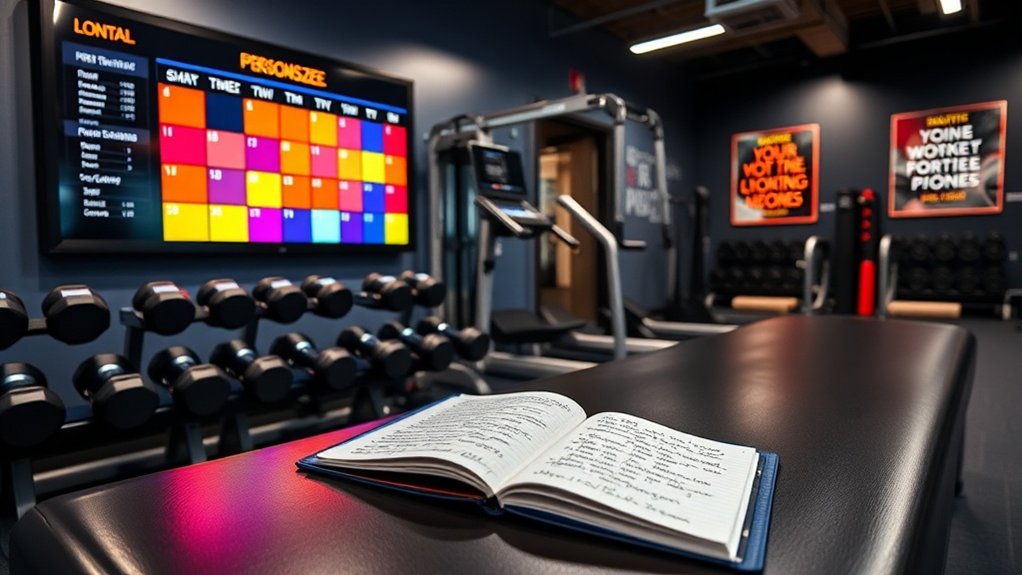
Your workout plan‘s success hinges on aligning exercise selection with your realistic time availability and accessible equipment resources.
Assess your weekly schedule to determine ideal training frequency—typically 2-4 sessions per week—while cataloging available resistance tools (free weights, bands, machines) that will dictate exercise modalities.
This practical framework guarantees your program fits your lifestyle constraints and environmental parameters, directly influencing long-term adherence and progressive overload capacity.
Available Time and Frequency
How much time can you genuinely allocate to exercise each week without compromising other essential commitments? Research supports that 2-4 training sessions per week effectively promotes adaptations while maintaining exercise consistency. Each session should span 30-60 minutes, though accumulated shorter bouts yield comparable benefits when scheduling constraints exist.
Your workout scheduling must account for realistic availability—morning sessions may suit early risers, while evening workouts accommodate those with demanding daytime obligations. Frequency selection depends on recovery capacity, training intensity, and lifestyle demands. A twice-weekly full-body protocol differs substantially from a four-day split routine in time requirements and recovery patterns.
Assess your weekly calendar honestly, identifying sustainable time blocks rather than idealistic projections. This pragmatic approach to workout scheduling improves long-term adherence and prevents program abandonment due to unrealistic temporal commitments.
Equipment and Environment Options
Since equipment availability fundamentally shapes exercise selection and progression strategies, you must inventory your accessible resources before finalizing program design. Document whether you’ll train with free weights, resistance bands, machines, or bodyweight-only methods.
Your training environment—commercial gym, home gym, or outdoor workouts—determines exercise variety and loading protocols. Space constraints in compact home gyms may necessitate adjustable dumbbells over full barbell setups, while outdoor workouts require weather-resistant equipment and portable tools.
Environmental factors influence recovery between sets, exercise tempo, and movement safety. You’ll achieve better adherence when your program matches your realistic access patterns rather than idealized scenarios.
This practical assessment prevents programming exercises you can’t actually perform, making sure your plan remains executable throughout the training cycle regardless of location changes or equipment limitations.
Recovery and Lifestyle Factors: Sleep, Stress, Nutrition, and Soreness Tolerance
Your workout plan’s effectiveness depends greatly on recovery factors that extend beyond the gym, particularly sleep quality and stress levels.
Adequate sleep (7-9 hours nightly) facilitates muscle repair through hormone regulation, while chronic stress raises cortisol and impairs recovery capacity.
Managing these physiological factors, alongside optimizing your nutrition and understanding your individual soreness tolerance, directly influences training adaptations and injury prevention.
Sleep and Stress Management
While you focus on training intensity and exercise selection, recovery determines whether your body adapts or breaks down. Your personalized workout plan must account for sleep quality and stress reduction, as both directly influence performance outcomes.
Adults require 7-9 hours of sleep nightly to optimize muscle repair and hormonal balance. When you’re sleep-deprived, your body struggles to recover, compromising strength gains and endurance improvements.
Chronic stress raises cortisol levels, which interferes with muscle growth and fat loss. Effective stress reduction strategies include:
- Meditation or breathing exercises
- Time management to prevent overtraining
- Scheduled recovery periods between intense sessions
Your trainer should assess both factors when designing your program.
If you’re consistently stressed or sleep-deprived, your plan needs modified volume and intensity to prevent overreaching while maintaining progress toward your goals.
Nutrition and Soreness Recovery
Recovery extends beyond sleep and stress management—what you eat directly impacts how quickly your muscles repair and adapt to training demands.
You’ll need adequate macronutrient balance, including carbohydrates for glycogen replenishment, proteins for muscle repair, and fats for hormone production. Micronutrients like vitamins and minerals further support these processes.
Your hydration strategies matter comparably—proper fluid intake before, during, and after workouts prevents dehydration that can worsen soreness and delay recovery.
Individual soreness tolerance varies considerably, so you’ll benefit from active recovery techniques like light exercise or stretching to alleviate discomfort.
When you combine ideal nutrition with effective hydration strategies, you’re creating the physiological conditions necessary for consistent progress. This nutritional foundation allows your body to handle increasing training loads effectively.
At-Home Assessment Protocol: Testing Your Baseline Fitness Level

Before designing an effective personalized workout plan, you’ll need quantifiable data points that reflect your current physical capabilities across multiple fitness domains.
These baseline measurements establish your starting point and enable precise progress tracking throughout your fitness evaluation.
Your thorough at-home assessment should include:
- Cardiovascular endurance: Record your pulse before and after walking one mile, or time yourself completing a 1.5-mile run
- Muscular strength: Count maximum push-ups (standard or modified) performed in one continuous set
- Body composition: Measure waist circumference at bellybutton level and calculate BMI
Additionally, assess flexibility by measuring range of motion in critical joints—hips, knees, ankles, shoulders, and elbows.
Document these metrics systematically, as they’ll serve as reference points for adjusting training intensity, exercise selection, and recovery protocols as you progress.
The Complete Personalization Questionnaire: From Inputs to Program Design
How do you transform raw assessment data into a periodized training blueprint that addresses your unique physiological constraints and performance objectives?
The personalization questionnaire synthesizes your demographic markers (age, gender, anthropometrics), movement history, and medical contraindications with your explicitly defined goals and timelines. This structured intake captures exercise preferences, environmental access, and equipment availability—critical variables determining adherence rates.
Your fitness tracking data provides objective baselines for load progression, while dietary patterns inform recovery capacity. Personal motivation factors receive equal weighting, as psychological readiness predicts program sustainability.
The aggregated inputs undergo systematic analysis: contraindications establish safety parameters, baseline assessments determine starting intensities, goals dictate periodization phases, and preferences shape modality selection.
This evidence-informed synthesis generates a client-specific program architecture that balances physiological adaptation principles with individual feasibility constraints.
Frequently Asked Questions
How to Create a Personalized Workout Plan?
Like mapping your hero’s journey, you’ll start with thorough fitness assessment—measuring strength, endurance, and mobility. Then establish SMART goal setting parameters. Combine these with your preferences, schedule, and equipment access to design your evidence-based progression plan.
What Are the Things You Consider in Creating Your Personalized Exercise Plan?
You’ll consider your fitness goals, current fitness level, exercise preferences, available equipment, time constraints, and any medical limitations. These factors guarantee your plan’s progressive overload, specificity, and sustainability while maximizing adherence and minimizing injury risk.
What Is the 3-3-3 Rule for Working Out?
You’ll transform fitness with this “groundbreaking” revelation: the 3-3-3 rule’s workout structure involves performing three sets of three exercises targeting three components—upper body, lower body, and core—making certain you’ve achieved balanced, evidence-based strength development efficiently.
What Is the 5 5 5 30 Rule?
The 5-5-5-30 rule prescribes five weekly workouts: five strength sessions targeting different muscle groups and five cardio sessions, each lasting 30 minutes minimum. Its 5-5-5 benefits include improved muscular development and cardiovascular health through consistent 5-5-5 application in your training regimen.