Your personalized lower body workout program should balance quad-dominant exercises like squats and leg presses with hip-dominant movements such as deadlifts and hip thrusts. You’ll need to train both movement patterns weekly, focusing on proper form before adding weight. Include hamstring curls and calf raises to prevent muscle imbalances that lead to injuries. Progress systematically from bodyweight variations to loaded exercises, adjusting volume and frequency based on your recovery capacity. The following sections explain exactly how to structure these elements for maximum strength gains.
Understanding Lower Body Biomechanics and Muscle Groups for Women

Your lower body houses the largest and most powerful muscle groups in your body, each serving distinct biomechanical functions that directly impact your movement quality, athletic performance, and injury resilience.
Understanding these muscle groups helps you develop effective strength training strategies. Your glutes—comprising the gluteus maximus, medius, and minimus—stabilize your hips and power movements like running and jumping.
Your quadriceps extend your knees during squats and lunges, while your hamstrings flex your knees and extend your hips, preventing sprint-related injuries.
The adductor muscles maintain proper leg alignment and stability throughout lower body movements.
Women’s biomechanics differ from men’s due to pelvic structure variations, influencing movement patterns and injury risk. This makes targeted lower body strength essential for building strong legs while addressing your specific anatomical considerations.
Quad-Dominant Exercises: Squats, Leg Press, and Progressive Variations
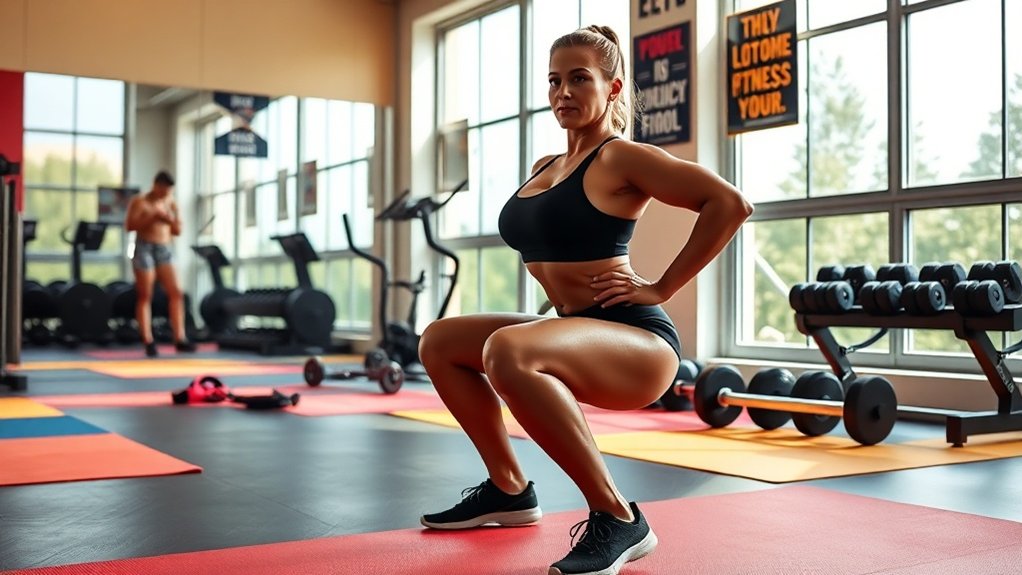
When building powerful quadriceps, you’ll rely on two fundamental movement patterns: squats and leg presses. These quad-dominant exercises develop knee extension capacity while boosting overall leg strength and lower body development.
Progressive Training Strategies for Ideal Results:
- Squat Variations – Progress from bodyweight squats to dumbbell and barbell variations, allowing controlled progressive overload for muscle growth.
- Leg Press Applications – Use the machine’s stability to focus purely on quad activation, perfect when balance challenges limit free weight performance.
- Advanced Techniques – Incorporate tempo squats and paused leg presses to maximize time under tension, accelerating strength gains.
These progressive variations systematically challenge your muscles, promoting hypertrophy while improving athletic performance.
Consistent application of these quad-dominant exercises builds the foundation for thorough lower body development and movement stability.
Hip-Dominant Movements: Deadlifts, Hip Thrusts, and Glute Development
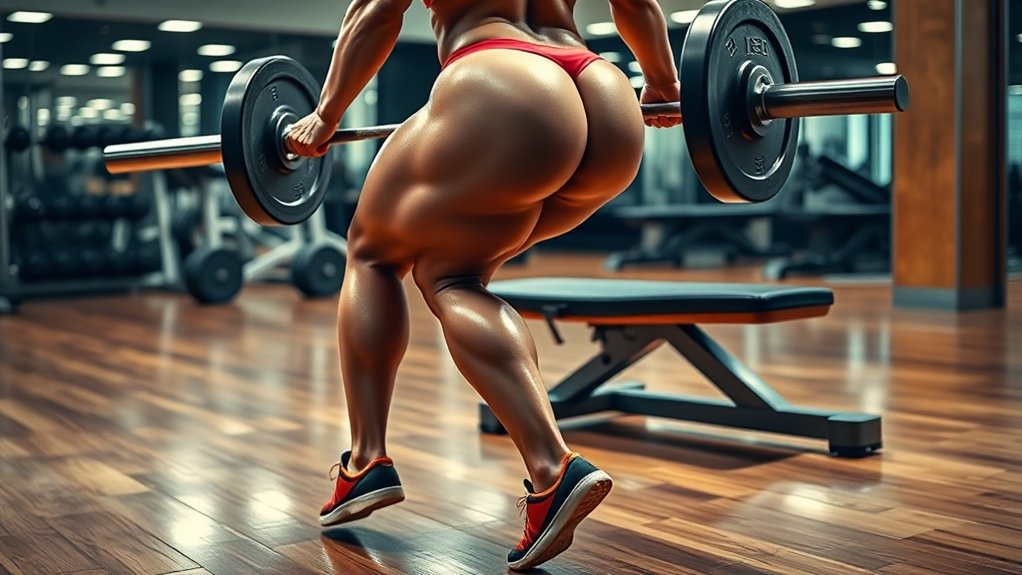
While quad-dominant exercises build anterior leg strength, hip-dominant movements develop the posterior chain—your glutes, hamstrings, and lower back—creating balanced lower body power and injury resilience.
Deadlifts engage your entire posterior chain, strengthening gluteal muscles and hamstrings through compound movement patterns essential for functional movements. Hip thrusts allow maximum glute activation with heavy loading, making them superior for targeted glute strength development.
| Exercise | Primary Muscle Recruitment | Injury Prevention Benefit |
|---|---|---|
| Conventional Deadlift | Hamstrings, glutes, erectors | Strengthens spine stabilizers |
| Romanian Deadlift | Hamstrings, glutes | Improves hip hinge mechanics |
| Hip Thrust | Gluteus maximus | Improves pelvic stability |
| Sumo Deadlift | Inner thighs, glutes | Reduces lower back strain |
Your workout routine should incorporate both movements weekly to maximize lower body strength and proper muscle recruitment patterns.
Hamstring and Calf Training for Balanced Lower Body Strength
Strong hamstrings and calves complete your posterior chain development, preventing the muscle imbalances that lead to knee injuries and Achilles tendon problems.
Your hamstring training should emphasize controlled eccentric movements through Romanian Deadlifts, which promote muscle growth while increasing stability throughout your lower body strength work.
Essential exercises for balanced posterior development:
- Romanian Deadlifts – Maintain a neutral spine while hinging at your hips, feeling the stretch through your hamstrings before driving through your heels.
- Seated or lying hamstring curls – Control both the lifting and lowering phases to maximize muscle activation.
- Standing and seated calf raises – Train through full range of motion for complete gastrocnemius and soleus development.
This combination builds overall leg power and functional fitness while prioritizing injury prevention through proper form and progressive overload.
Creating Your Personalized Lower Body Workout Program: Volume, Frequency, and Progressions
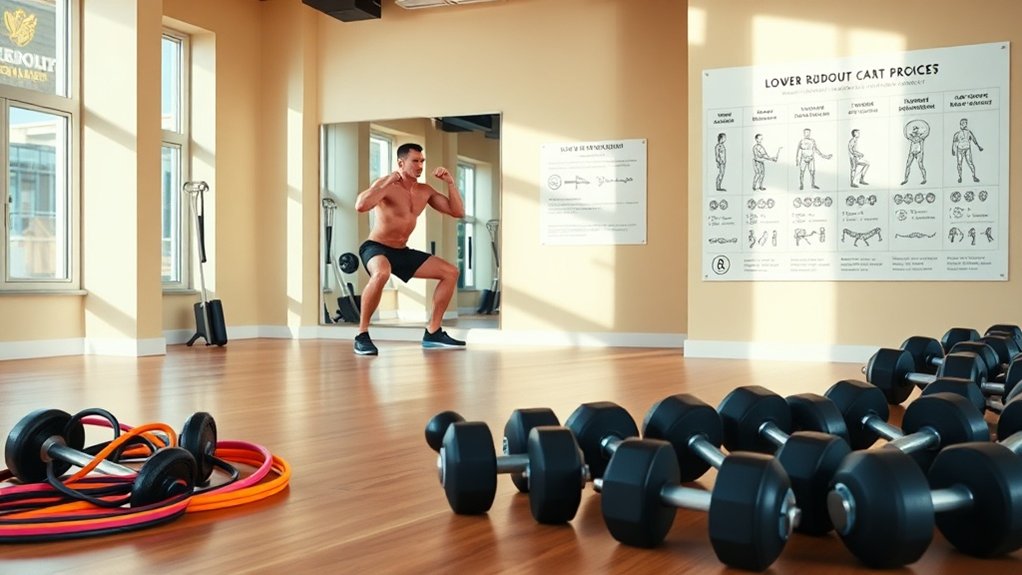
Your lower body workout program requires three fundamental elements: appropriate training volume, strategic frequency, and systematic progression.
For peak muscle growth in your legs and glutes, perform 3-4 sets of each leg exercise with 8-12 repetitions. Schedule lower body sessions 1-2 times weekly, allowing adequate recovery between workouts.
Implement progressive overload by systematically increasing weights, adding sets or reps, or reducing rest intervals. This approach guarantees your strength training program continually challenges your muscles.
Consider incorporating supersets or circuit training to improve efficiency while maintaining engagement. Track progress using workout charts to monitor improvements and adjust your workout plan accordingly.
This systematic approach assists you in achieving your fitness goals while preventing overtraining and maintaining proper form throughout your training journey.
Knee-Friendly Exercise Alternatives and Addressing Common Lower Body Weaknesses
When knee discomfort limits your lower body training, specific exercise modifications can maintain your progress without exacerbating joint stress.
Knee-friendly exercise alternatives like glute bridges and step-ups effectively strengthen your glute muscles while protecting vulnerable joints. You’ll address common weaknesses by targeting areas that directly impact lower body biomechanics.
Essential strategies for knee-conscious training:
- Master proper form during bodyweight squats and eccentric exercises like Romanian deadlifts to build muscle strength and control.
- Incorporate eccentric squats to develop controlled movement patterns that reduce joint stress.
- Strengthen your inner and outer thigh muscles through targeted movements to correct imbalances affecting stability.
Frequently Asked Questions
What Is the 3-3-3 Rule for Workout?
The 3-3-3 workout means you’ll perform three sets of three exercises targeting one muscle group. Benefits of 3-3-3 include efficient muscle recovery and progression tracking. You’ll alternate exercises while incorporating rest, adjusting intensity levels and workout duration safely.
Is It Okay to Train Legs and Glutes Together?
Yes, you’ll maximize strength gains by combining leg training and glute training. Studies show 80% improved performance when these muscle groups train together. Your workout intensity increases while maintaining proper form, supporting personal goals through strategic training splits and adequate muscle recovery.
What Is the 5 4 3 2 1 Workout Method?
The 5 4 3 2 1 workout structure sequences five exercises with descending reps, progressively increasing intensity levels. You’ll experience strength progression benefits through varied exercise combinations, supporting your fitness goals while allowing proper muscle recovery between training frequency sessions.
What Is the 6 12 25 Rule?
You’ll do 6 heavy reps, 12 moderate, then 25 light reps per exercise—because apparently counting to three got boring. This resistance training method targets muscle hypertrophy through varied workout intensity, optimizing your leg workout while requiring adequate recovery time between sessions.