Personalized workout plan apps excel at generating adaptive routines through AI algorithms that analyze your fitness history and adjust programming based on performance metrics. They provide structured progression, exercise variety, and progress visualization at a fraction of traditional coaching costs. However, they struggle with accountability—retention drops to 8.48% by day 30—and can’t offer real-time form corrections or address individual movement compensations. The 42% adherence rate compared to 73% with human coaching reveals where algorithmic precision meets its limits, though understanding which features actually matter for your specific goals changes the equation entirely.
What Personalized Workout Plan Apps Actually Do
While traditional fitness plans follow a one-size-fits-all approach, personalized workout plan apps use artificial intelligence algorithms to analyze your specific data points—including fitness history, current performance levels, stated goals, and available equipment—then generate customized routines designed to optimize your training outcomes.
This workout customization extends beyond basic exercise selection; the apps continuously adapt programming based on real-time feedback and performance tracking metrics you provide.
The user experience encompasses multiple training modalities—strength training, HIIT, yoga—confirming you’ll access routines matching your preferences and capabilities.
Integration with wearable devices provides extensive health data visibility, while accountability mechanisms like scheduled reminders and progress-sharing features maintain engagement consistency.
You’re fundamentally receiving algorithm-driven coaching that adjusts as your fitness evolves, replacing static workout templates with dynamic, responsive programming.
The Strengths: Where These Apps Excel
The algorithmic precision underlying these apps delivers measurable advantages that static fitness programs can’t match. You’ll receive workouts calibrated to your specific measurements, fitness history, and objectives—data-driven customization that drives superior user engagement compared to generic routines.
AI-powered systems analyze your performance metrics in real-time, creating adaptive workouts that scale intensity as you progress. This responsive programming prevents both undertraining and overexertion.
Progress tracking features visualize your achievements through quantifiable data, reinforcing adherence through tangible evidence of improvement. Integration with wearable devices consolidates health metrics into a unified dashboard, increasing accountability.
Community elements—leaderboards and social sharing—influence competitive psychology to sustain motivation. These combined features create a feedback loop that maintains long-term participation rates considerably higher than traditional fitness approaches.
The Limitations: What Gets Lost in Automation

You’ll find that automated workout apps can’t replicate the accountability mechanisms inherent in human coaching relationships, where a trainer monitors your commitment and adjusts motivation strategies based on your psychological state.
The AI-driven form guidance in these platforms relies on generalized biomechanical models that may not detect your specific movement compensations or postural deviations, increasing injury risk.
Research indicates that remote coaching with human oversight produces markedly better adherence rates (73% vs. 42%) and form accuracy compared to fully automated systems.
Missing Human Accountability Factor
The data reveals three critical gaps:
- Retention collapse: Only 8.48% of users remain active by day 30, demonstrating how quickly motivation fades without personal oversight.
- Emotional barriers unaddressed: Apps can’t identify or help you overcome psychological obstacles that trained professionals recognize immediately.
- Isolation effect: You miss the community support and real-time encouragement inherent in traditional coaching environments.
Without regular check-ins and personalized adjustments from a human coach, you’re statistically more likely to lose consistency and ultimately abandon your fitness goals.
Generic AI Exercise Form
While AI can track your reps and sets, it fundamentally can’t see what matters most: your form. Generic recommendations from automated systems miss the biomechanical nuances that prevent injury and maximize results.
Without real-time visual feedback, you’re left guessing whether your squat depth is appropriate or if your shoulder positioning during presses puts you at risk.
These algorithms can’t account for user limitations like previous injuries, mobility restrictions, or structural variations that demand exercise modifications. A one-size-fits-all approach ignores how your body distinctly responds to movement patterns.
The absence of corrective feedback means poor form becomes habitual, compounding risk over time. What you need isn’t just a workout plan—it’s biomechanical assessment that adapts to your individual movement quality and physical constraints.
Understanding AI-Powered Personalization vs. Human Coaching
You’re now choosing between two distinct approaches to fitness guidance: AI algorithms that process your performance data to generate adaptive workout plans, and human coaches who provide emotional intelligence alongside technical expertise.
AI excels at rapid data analysis and real-time plan adjustments based on your metrics, while human coaches offer nuanced injury assessment, motivational support during setbacks, and accountability through personal connection.
The fitness industry is responding to this gap by developing hybrid models that combine AI’s computational power with scheduled human coach check-ins, aiming to deliver both data-driven precision and the emotional support that research shows users consistently prefer.
How AI Customizes Workouts
When you open an AI-powered workout app like Fitbod, sophisticated algorithms immediately begin analyzing your fitness level, training goals, and performance history to construct a training plan tailored specifically to your capabilities.
These adaptive algorithms continuously refine your program through three key mechanisms:
- Real-time performance tracking that monitors your completed sets, weights, and recovery patterns to adjust subsequent workouts
- User feedback integration that processes your post-workout ratings and energy levels to modify exercise selection and intensity
- Progressive load improvement that calculates ideal weight increases and volume adjustments based on your demonstrated strength gains
The system processes this data instantaneously, making evidence-based modifications that would require extensive manual calculation from a human coach.
You’ll receive video demonstrations and coaching cues for each exercise, making certain proper form throughout your personalized program.
Human Coach Benefits
AI-powered algorithms excel at processing performance data and adjusting variables like volume and intensity, but they can’t observe the subtle compensatory movements in your shoulder during overhead presses or detect when you’re favoring one leg during squats. Human coaches provide real-time technique corrections that prevent injury patterns before they develop.
| Human Coach Advantages | AI App Limitations |
|---|---|
| Reads body language and fatigue signals | Relies solely on self-reported metrics |
| Adapts to mental state and external stressors | Cannot assess lifestyle factors affecting performance |
| Builds human connection through shared experiences | Lacks empathetic understanding of personal challenges |
| Delivers emotional support during plateaus | Provides algorithmic adjustments without encouragement |
This combination of technical expertise and emotional support creates accountability that greatly improves adherence to fitness programs.
Hybrid Models Emerging
As fitness technology matures, hybrid models are bridging the gap between algorithmic efficiency and human intuition.
You’re now seeing apps that use AI for data-driven workout adaptation while maintaining certified trainers for accountability and motivation. This combination addresses limitations inherent in purely automated or exclusively coach-based approaches.
The hybrid approach delivers measurable advantages:
- Real-time adaptation: AI analyzes your performance metrics to modify training variables instantly.
- Human accountability: Regular check-ins with trainers provide motivation that algorithms can’t replicate.
- Higher retention: Personalized plans adjust to your evolving goals while coaches address emotional barriers.
Research confirms you’ll experience greater satisfaction and improved results when engaging both AI features and human coaching elements.
Apps like Future and Fitbod demonstrate how fitness technology can optimize personalization without sacrificing the irreplaceable human connection.
Essential Features Worth Prioritizing
Although the market offers hundreds of workout apps, only those with specific core features deliver measurable results for users seeking sustainable fitness improvements. Prioritize apps that adapt programming based on user feedback and real-time performance data. Integration with wearable devices provides essential health metrics that inform training adjustments and track progress accurately.
| Feature Category | Core Capability | Impact on Results |
|---|---|---|
| Adaptive Programming | AI-driven workout modifications | Prevents plateaus, optimizes progression |
| Device Integration | Real-time metric synchronization | Enables data-driven decision making |
| Content Diversity | Multiple training modalities | Sustains user engagement long-term |
| Interface Design | Intuitive navigation and tracking | Reduces friction, improves adherence |
Apps incorporating regular content updates maintain user engagement by introducing novel stimuli that challenge your body differently. This systematic approach to feature selection guarantees you’re investing time in platforms designed for measurable fitness outcomes.
Common Gaps You Should Expect
Despite sophisticated personalization algorithms, most workout apps demonstrate systematic deficiencies that compromise your long-term fitness outcomes.
You’ll encounter three critical limitations:
- Inadequate nutrition integration prevents holistic health tracking, forcing you to manage dietary data separately from your training protocols.
- Absent real-time form correction means you’ll miss immediate user feedback on technique errors, increasing injury risk and reducing exercise effectiveness.
- Weak community infrastructure diminishes user engagement through limited social accountability mechanisms, directly correlating with higher abandonment rates post-onboarding.
Equipment dependencies further restrict accessibility—bodyweight-focused users face constrained program options.
The retention challenge stems from stagnant content libraries that fail to deliver progressive variety.
These gaps indicate you shouldn’t expect a complete fitness solution from standalone workout apps without supplementary resources or integrations.
Matching App Capabilities to Your Training Goals
Before committing to a subscription, you must systematically evaluate whether an app’s technical architecture supports your specific training methodology. Apps like Fitbod and The Shred App employ AI-driven algorithms to process your fitness history and objectives, but their effectiveness depends on goal alignment with available workout modalities.
If you’re pursuing strength-focused hypertrophy, verify the app provides progressive overload tracking. For endurance athletes, confirm cardiovascular programming matches your periodization needs. HIIT practitioners should confirm interval customization capabilities.
Influence the standard seven-day trial period to test how the app’s progress tracking visualizations support your advancement monitoring requirements.
While personalized programming improves initial user engagement, some platforms lack interactive features that sustain long-term motivation. Evaluate whether the app’s technical capabilities directly support your measurable training outcomes.
When an App Is Enough (And When It Isn’t)
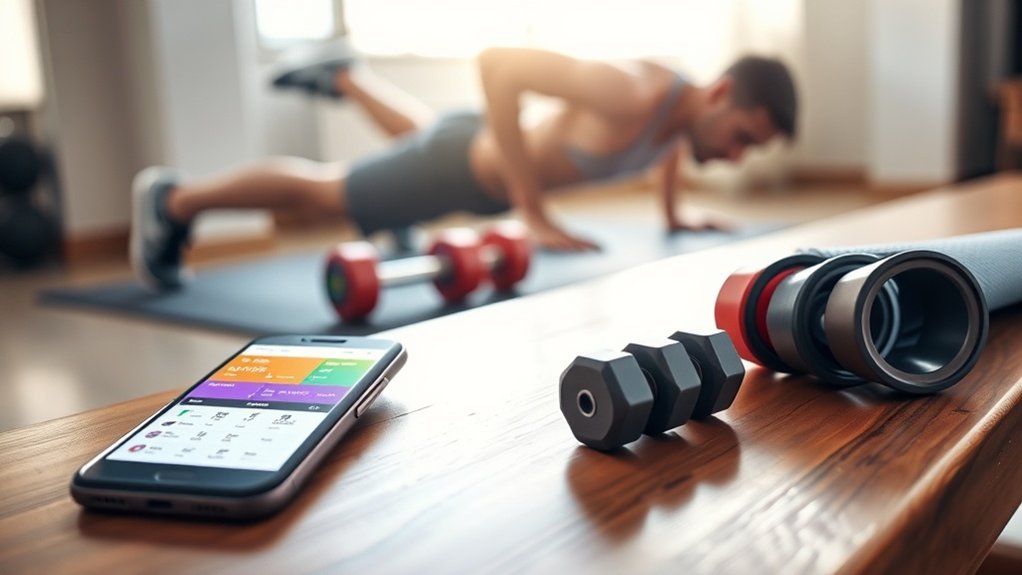
When your training demands center on standardized progression protocols and exercise variety, algorithmic workout apps deliver measurable results without the premium cost of human coaching.
You’ll find apps sufficient when pursuing general fitness improvements, basic strength development, or maintaining consistent exercise habits through structured programming.
However, app limitations become apparent in three critical scenarios:
- Injury recovery or pre-existing conditions requiring movement modifications and real-time form assessment
- Competition preparation demanding periodization nuances and technical refinement beyond automated programming
- Plateau breakthrough necessitating individualized problem-solving that transcends data patterns
The user experience deteriorates when you need accountability mechanisms stronger than push notifications.
Research shows 30-day retention rates collapse without human interaction. Apps excel at delivering workouts; they struggle providing the adaptive feedback and motivational architecture that complex training goals demand.
Frequently Asked Questions
What Is the Best Personalized Workout App?
Based on app comparisons and user reviews, Future App’s elite personal trainers deliver the most thorough personalized experience, though it’s pricier. You’ll find better value with Fitbod for strength training or BetterMe if you’re starting out.
What Is the 3-3-3 Rule for Workout?
The 3-3-3 rule optimizes workout efficiency through three components: three sets, three exercises, three muscle groups. You’ll perform 8-12 repetitions per set, targeting major muscles with compound movements that maximize engagement while maintaining balanced strength development.
What Is the 3/2/1 Rule in Gym?
The 3/2/1 rule structures your training with three heavy sets, two moderate-intensity reps, and one endurance set. Its 3/2/1 benefits include improved strength and stamina, while 3/2/1 application spans weightlifting to bodyweight exercises for thorough fitness development.
Are Workout Apps Actually Effective?
Yes, workout apps prove effective when you consistently use their app features for 30+ days. User feedback confirms personalized programs increase engagement, though retention drops from 28% to 8.48% monthly, making sustained commitment essential for results.