
You’ll find proven workout templates structured around core movement patterns—push, pull, squat, and hinge—that address specific goals from beginner strength building to advanced powerlifting. Real-world examples include a 3-day full-body foundation plan, 4-day hypertrophy splits, and 5-day metabolic conditioning programs that balance exercise selection with strategic recovery. These templates incorporate progressive overload protocols, deload weeks, and client feedback mechanisms to prevent plateaus and reduce injury risk. The following breakdown reveals how each template adapts to individual needs while maintaining evidence-based programming principles.
Why Real-World Template Examples Matter for Program Design

When trainers examine proven workout templates from established programs, they gain immediate insight into the structural elements that drive client results.
You’ll uncover how successful templates balance exercise selection, progression protocols, and recovery strategies—components that directly impact your clients’ safety and long-term adherence.
The template benefits extend beyond time savings.
You’ll learn to categorize movements by intensity and type, assuring program consistency across your entire client roster. This systematic approach helps you maintain professional standards while adapting plans to individual limitations and preferences.
Real-world examples reveal how experienced trainers address common programming challenges.
You’ll see practical solutions for exercise variety, load progression, and deload weeks—critical factors that prevent plateaus and reduce injury risk while keeping clients engaged throughout their fitness journey.
Beginner Full-Body Strength Template: 3-Day Foundation Plan
As you design programs for novice lifters, the three-day full-body template establishes a sustainable foundation that prioritizes movement quality over training volume. Your beginner exercise selection should center on foundational movement patterns: squats, pushes, and pulls. Incorporate exercises like trap bar deadlifts, front squats, and military presses, scheduling sessions on non-consecutive days (Monday, Wednesday, Friday) to allow proper recovery.
Structure each workout with 2-4 sets of 8-12 repetitions, balancing compound movements with targeted isolation work.
You’ll need to include thorough warm-up protocols and cool-down sequences—these aren’t optional for beginners adapting to resistance training. This approach guarantees your clients master proper form while building strength progressively.
Consistency matters more than intensity at this stage, so emphasize adherence through manageable workloads and adequate rest periods between training days.
Intermediate Hypertrophy Template: 4-Day Push/Pull/Legs Split
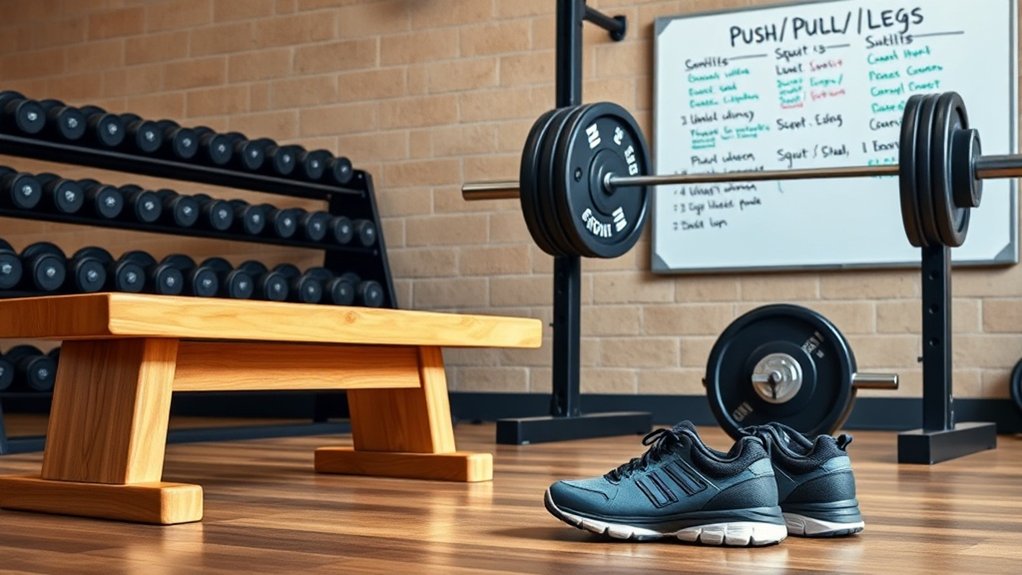
The four-day push/pull/legs split represents the ideal progression for intermediate lifters who’ve mastered foundational movement patterns and can handle increased training volume. This template dedicates specific days to chest, shoulders, and triceps (push), back and biceps (pull), and lower body development, allowing you to target muscle groups with greater focus while maintaining adequate recovery.
| Training Day | Primary Muscles | Exercise Count |
|---|---|---|
| Push | Chest, Shoulders, Triceps | 4-6 exercises |
| Pull | Back, Biceps | 4-6 exercises |
| Legs | Quads, Hamstrings, Calves | 4-6 exercises |
You’ll work within 8-12 rep ranges to maximize hypertrophy while progressively increasing weights weekly. The template’s flexibility accommodates exercise modifications based on your equipment access, injury history, or individual response patterns, assuring consistent muscle adaptation without compromising safety.
Fat Loss With Recovery Template: 5-Day Metabolic Conditioning Plan
While building muscle requires strategic volume and recovery cycles, fat loss demands a different metabolic approach that balances energy expenditure with adequate regeneration.
This 5-day template combines HIIT sessions with strength circuits, using compound movements to maximize calorie burn while preserving lean tissue. You’ll perform metabolic workouts on non-consecutive days, allowing proper recovery between intense sessions.
Your plan integrates active recovery days featuring low-intensity activities like walking or yoga, emphasizing recovery importance for sustained fat loss strategies.
Each workout targets multiple muscle groups simultaneously, promoting your metabolism for hours post-exercise. You’ll track body measurements and performance metrics weekly, enabling data-driven adjustments to intensity and volume.
This structured approach prevents overtraining while maintaining the metabolic stimulus necessary for consistent fat loss results.
Athletic Performance Template: 6-Day Speed and Power Development

Your 6-day athletic performance template strategically distributes power, speed, and recovery work across the week to maximize explosive strength while preventing overtraining.
You’ll focus on compound movements like squats and deadlifts paired with plyometric exercises such as box jumps to build the force production needed for competitive athletics.
Each session incorporates specific speed development protocols—including sprint mechanics and acceleration drills—that translate directly to improved performance in your sport.
Weekly Training Split Structure
When developing speed and power for athletic performance, you’ll need a structured 6-day training split that strategically alternates between explosive movements, maximal strength work, and targeted recovery sessions.
Your training frequency should distribute workload effectively: dedicate Day 1 to speed work and plyometrics, Day 2 to lower body strength with compound lifts like squats, Day 3 to upper body power, Day 4 to agility and sport-specific drills, Day 5 to total body explosive movements, and Day 6 to technical skills.
Each session pairs compound exercises with explosive movements—such as deadlifts followed by box jumps—to maximize power output.
You’ll implement recovery strategies including active rest periods and progress tracking to adjust load, intensity, and volume based on your performance metrics and recovery status, assuring safe adaptation while minimizing injury risk.
Key Power Exercises
The foundation of speed and power development rests on five primary movement patterns: Olympic lifts, plyometric exercises, loaded jumps, resisted sprints, and ballistic throws.
You’ll develop explosive strength through movements that demand rapid force production while maintaining proper mechanics.
Your power development centers on these essential exercises:
- Olympic Lifts: Clean and Jerk and Snatch variations recruit multiple muscle groups simultaneously, teaching your body to generate maximum force quickly.
- Plyometric Drills: Depth Jumps and Broad Jumps improve reactive strength through the stretch-shortening cycle.
- Box Jumps: These loaded movements bridge the gap between strength and speed expression.
Each exercise targets specific energy systems that directly boost athletic performance.
You’ll progress systematically through intensity zones, confirming your technique remains sound before advancing load or complexity.
Speed Development Protocols
Ideal speed development requires a systematic approach that balances high-intensity neural training with adequate recovery, which is precisely what this 6-day protocol delivers.
You’ll engage in structured warm-ups before every session to prime your neuromuscular system and minimize injury risk. The template splits your focus between acceleration mechanics and maximum velocity work, assuring you’re building complete speed capabilities.
You’ll perform targeted speed drills alongside plyometric exercises that improve your explosive power output. Strategic rest periods are built into your weekly structure, allowing your central nervous system to recover between demanding sessions.
You’ll track your performance metrics consistently, providing concrete data on your improvements in both speed and power development over time.
Functional Fitness Template: 4-Day Movement-Based Program

Your 4-day functional fitness program should organize workouts around fundamental movement patterns—pushing, pulling, squatting, and hinging—to guarantee balanced muscle development and injury prevention.
Each training day targets specific movement categories while incorporating compound exercises that translate directly to real-world activities and daily tasks.
This structure allows you to train multiple muscle groups efficiently while providing adequate recovery time between sessions, making it sustainable for long-term adherence and progressive strength gains.
Program Structure and Layout
Building a functional fitness program around four distinct movement patterns—push, pull, squat, and hinge—creates a balanced framework that develops real-world strength and mobility.
You’ll structure each session with three essential components:
- Warm-up (5-10 minutes): Dynamic stretches and movement prep specific to your daily workout pattern
- Main workout (30-40 minutes): Compound exercises followed by targeted accessory work, with 8-15 reps for ideal strength endurance
- Cool-down (5-10 minutes): Static stretching and mobility drills to improve recovery
This template incorporates exercise variations and workout modifications throughout, allowing you to adjust intensity based on your current fitness level.
You’ll train multiple muscle groups simultaneously while building cardiovascular capacity.
The structured approach makes sure you’re engaging safely while progressing consistently toward your functional fitness goals.
Exercise Selection by Day
Each training day in this 4-day program targets a specific movement pattern to build balanced strength and prevent overtraining.
Day 1 focuses on upper body pushing and pulling with exercise variations like push-ups, pull-ups, and overhead presses.
Day 2 emphasizes lower body strength through squats, deadlifts, and lunges that develop foundational movement patterns.
Day 3 combines core stability work—including planks and medicine ball twists—with dynamic full-body movements like kettlebell swings to improve coordination and power.
Day 4 delivers cardiovascular conditioning through HIIT or circuit training that blends strength and aerobic work.
You’ll include proper warm-up and cool-down phases in each session to promote recovery and reduce injury risk.
This structured approach guarantees you’re developing thorough functional fitness while allowing adequate recovery between similar movement patterns.
Advanced Strength Template: 5-Day Powerlifting-Focused Protocol
When you’re ready to push beyond intermediate programming, a 5-day powerlifting-focused protocol delivers the training volume and specificity needed to maximize strength in the squat, bench press, and deadlift.
This template dedicates separate days to each competition lift while incorporating powerlifting variations and accessory work.
Your weekly structure should include:
- Competition lift days using 3-5 rep ranges for primary movements, followed by variation work (pause squats, close-grip bench, deficit deadlifts)
- Accessory sessions targeting weak points with 6-8 reps to build muscle and prevent imbalances
- Strategic recovery techniques including lighter training days, proper nutrition with adequate protein and creatine, and mobility work during warm-ups
Each session begins with movement-specific warm-ups and lighter sets to prepare your body for heavy loads while minimizing injury risk.
Endurance Athlete Template: 4-Day Cross-Training Program
While powerlifting protocols zero in on maximal strength, endurance athletes require a fundamentally different approach that builds cardiovascular capacity without sacrificing the structural support needed for long-duration activities.
This 4-day template delivers endurance training through strategic exercise rotation—running, cycling, and swimming—preventing overuse injuries common to single-sport athletes. You’ll experience cross training benefits by targeting different energy systems each session, from one weekly long-distance run building aerobic capacity to high-intensity intervals developing speed and power.
Strength sessions incorporate squats, lunges, and core work to improve muscular endurance and joint stability essential for sustained performance. Integrated recovery days aren’t optional—they’re when adaptation occurs, allowing your body to consolidate training gains while maintaining peak session quality throughout the week.
Understanding Deload Weeks and Progression Strategies Across Templates
You’ll maximize your training results by strategically incorporating deload weeks—periods of reduced intensity and volume that allow your body to recover from accumulated fatigue while preventing overtraining and injury.
Progressive overload, the systematic increase of training demands over time, forms the foundation of continuous improvement across all workout templates.
Understanding how to implement both strategies guarantees you’re building strength safely and sustainably rather than pushing yourself into a state of chronic fatigue or burnout.
What Are Deload Weeks
Though your training program demands consistent effort and progressive overload, your body requires strategic recovery periods to adapt and grow stronger.
Deload weeks are planned seven-day phases where you intentionally reduce training intensity and volume while maintaining movement patterns. These recovery strategies prevent overtraining and optimize long-term results.
During a deload week, you’ll implement these modifications:
- Reduce weights to 40-60% of your normal working loads
- Decrease total sets and repetitions per exercise
- Maintain proper form while eliminating excessive physical strain
The deload benefits extend beyond physical recovery. Research confirms that well-timed deloads improve muscle repair, restore psychological readiness, and sustain motivation throughout extended training cycles.
You’ll typically schedule these recovery weeks after 3-4 cycles of progressive loading, allowing your body to consolidate adaptations before tackling new challenges.
Progressive Overload Implementation Methods
Recovery weeks create the foundation, but systematic progression builds the results you’re working toward. Progressive overload techniques require strategic implementation across your training templates.
You’ll increase weights by 2-5% when completing all prescribed repetitions with proper form, or add 1-2 repetitions per set before advancing load. Alternatively, you can reduce rest periods by 15-30 seconds to intensify training stimulus without changing exercises.
Tracking progress through detailed workout logs proves essential for safe advancement. Record weights, repetitions, and perceived exertion for each session, allowing you to identify readiness for progression objectively.
When performance plateaus or form deteriorates, it’s time for your scheduled deload week rather than pushing harder. This evidence-based approach prevents injury while maintaining consistent strength gains, assuring your personalized template delivers sustainable results.
How to Adjust Templates Based on Client Feedback and Progress Markers
While creating a workout template provides structure, its true value emerges when you adapt it based on how your client responds. Regularly gather client feedback on perceived exertion, enjoyment, and discomfort to inform your modifications.
Combine this qualitative data with objective progress markers like strength gains, endurance improvements, and body composition changes.
Implement these adjustment strategies:
- Conduct systematic reviews every 4-6 weeks to reassess goals and make strategic modifications that maintain engagement
- Introduce exercise variations or rep range changes when feedback indicates monotony or plateaus
- Track performance metrics over time through workout logs to identify trends requiring plan adjustments
This data-driven approach guarantees your templates remain effective while accommodating individual client needs, preventing stagnation and promoting sustainable progress toward their fitness objectives.
Frequently Asked Questions
Can I Combine Exercises From Different Templates Into One Program?
Like a chef combining recipes, you can absolutely blend exercises from different templates. Exercise integration through program customization lets you create effective workouts tailored to your goals, provided you maintain proper progression, recovery balance, and movement quality throughout.
How Do I Choose Between Two Templates With Similar Goals?
For template comparison, you’ll want to assess which program better matches your current fitness level, available equipment, and schedule. Prioritize goal alignment by selecting the template with exercises you can perform safely and consistently long-term.
What Equipment Is Needed for Each Workout Template?
Don’t put the cart before the horse—check each template’s workout essentials first. You’ll find equipment variations ranging from bodyweight-only to full gym setups. Choose based on what you’ve got access to and your safety requirements.
Can These Templates Work for Home Workouts Without a Gym?
Yes, you’ll achieve excellent home workout effectiveness using bodyweight exercises. You’ll gain strength, endurance, and flexibility through bodyweight exercise benefits like push-ups, squats, and planks—no gym required. These evidence-based movements safely deliver real results.
How Long Should I Follow One Template Before Switching?
You’ll get ideal workout adaptation by following a template duration of 4-6 weeks. This timeframe lets your body respond to training stimuli while preventing plateaus. After that, you’re ready to progress or modify your routine for continued results.