Personalized workout plans begin with a thorough assessment of your movement patterns, fitness level, and specific goals, then continuously adapt exercises, loads, and schedules based on your real-time progress and recovery—while generic programs apply identical exercises and rep schemes to everyone without initial evaluation or ongoing adjustments. This fundamental difference determines whether you’ll train safely within your capabilities, avoid plateaus through strategic progression, and actually reach your objectives, or risk injury and suboptimal results from standardized templates that ignore your individual needs, limitations, and lifestyle constraints—distinctions that become clearer when you examine how each approach handles assessment, exercise selection**, and adaptation.
What Defines a Personalized Workout Plan and How It Differs From Generic Programs
While generic workout programs cast a wide net with standardized exercises and rep schemes, personalized workout plans begin with a thorough assessment of your current fitness level, movement quality, and specific goals.
This initial evaluation identifies your physical limitations and movement patterns, assuring every exercise suits your unique capabilities.
The personalized benefits extend beyond safety—your plan evolves through continuous progress tracking and regular adjustments, preventing plateaus that plague static programs.
You’ll receive real-time feedback from trainers who modify exercises based on your recovery needs and advancing abilities.
Generic limitations become apparent when one-size-fits-all approaches ignore individual nuances.
Without accounting for your health history or biomechanical differences, these programs risk injury and deliver suboptimal results, lacking the accountability and adaptation essential for sustained progress.
The Assessment Phase: Data-Driven Design Versus No Initial Evaluation
Your fitness journey’s success hinges on what happens before your first workout: personalized plans start with a thorough assessment that measures your movement quality, injury history, and physiological capabilities to create a data-driven training blueprint.
Generic programs skip this critical evaluation phase entirely, assuming your body responds similarly to millions of other users despite your unique biomechanics and health status.
This fundamental difference determines whether you’ll train with precision targeting your specific needs or follow a one-size-fits-all approach that ignores your individual starting point.
Comprehensive Initial Assessment Process
Before you perform a single repetition, a personalized workout plan requires you to complete a thorough initial assessment that examines your movement patterns, strength capabilities, and injury history.
This data-driven approach establishes baseline assessment metrics through health evaluations and performance testing, creating a foundation for your customized program design. These evaluation techniques measure your current fitness level and identify movement limitations that could lead to injury.
Generic programs skip this essential step entirely, assuming you share identical capabilities with every other user.
Without personalized assessment metrics, these one-size-fits-all approaches can’t account for your unique biomechanical patterns or health considerations.
This absence of initial evaluation creates significant risks—you might receive exercises that don’t match your abilities, potentially causing injury or delivering poor results that waste your training time.
Generic Programs Skip Evaluation
Generic workout programs operate without any baseline data about your body, treating your specific biomechanical profile as irrelevant to your training outcomes.
This approach represents one of the most significant generic plan pitfalls—you’re fundamentally following exercises designed for an imaginary average person who doesn’t exist.
Without understanding your movement limitations, injury history, or current fitness capacity, these programs can’t account for factors that directly impact your safety and results.
The assessment importance becomes clear when you consider that skipping this phase means you’re training blind, unable to identify muscle imbalances, mobility restrictions, or compensatory patterns that could derail your progress.
You’re left guessing whether exercises suit your body’s unique needs and capabilities.
Exercise Selection and Programming: Goal-Driven Customization Versus One-Size-Fits-All Templates
When you commence on a fitness journey, the exercises you perform determine whether you’ll reach your goals or spin your wheels in frustration. Personalized plans prioritize goal specificity, selecting movements that directly address your objectives, limitations, and movement patterns. Generic templates ignore these variables entirely.
| Personalized Plans | Generic Programs |
|---|---|
| Assess injuries and mobility restrictions | Apply identical exercises to everyone |
| Adjust for your equipment and schedule | Assume universal gym access |
| Progress based on your performance data | Follow rigid, unchanging protocols |
| Incorporate program adjustments as you advance | Risk plateaus from static programming |
| Align exercise selection with specific goals | Use arbitrary, disconnected movements |
Research confirms customized exercise selection produces superior strength, endurance, and body composition outcomes. You’ll experience faster results when training matches your individual needs rather than following cookie-cutter templates.
Progression Models: Individualized Load Management Versus Fixed Prescriptions
Selecting the right exercises establishes your training foundation, but how you progress those movements separates effective programming from wasted effort.
Individualized progression adjusts loads based on your real-time performance, recovery status, and daily energy levels—factors that fixed prescriptions completely ignore. While generic programs apply identical weight and rep schemes regardless of individual capacity, personalized plans incorporate regular assessments to modify adaptive intensity according to your body’s responses.
This approach prevents both overtraining and undertraining while encourageing continuous improvement through gradual progression. Research demonstrates that tailored regimens produce superior strength and endurance outcomes compared to one-size-fits-all templates, with participants experiencing faster gains and fewer plateaus.
You’ll also reduce injury risk considerably when programming responds to your actual capabilities rather than arbitrary standards.
Schedule Flexibility and Exercise Substitutions: Adaptive Training Versus Rigid Calendars

Your training schedule must accommodate real-world shakeions—missed sessions, high-stress workdays, or unexpected fatigue—which personalized programs address through immediate session rescheduling and volume adjustments based on your current capacity.
Generic programs lock you into predetermined training days regardless of recovery status or life circumstances, increasing injury risk and adherence failure.
Personalized plans also provide exercise alternatives when equipment isn’t available or movements cause discomfort, whereas fixed programs offer no substitution protocols, forcing you to skip sessions entirely or train through suboptimal conditions.
Real-Time Schedule Adjustments
Because life rarely follows a predictable pattern, your training program shouldn’t either. Personalized workout plans enable real time adjustments that accommodate sudden changes in your availability or energy levels. When you’re experiencing unexpected fatigue or schedule conflicts, your trainer can modify your workout immediately—shifting session times, reducing volume, or restructuring exercises to match your current capacity.
Generic programs operate on fixed calendars that don’t account for your daily variations. This rigidity forces you to either skip workouts entirely or push through when conditions aren’t ideal, increasing injury risk and burnout potential.
Flexible scheduling in personalized plans allows you to maintain consistency without compromising safety. You’ll train when your body’s ready, not when an arbitrary calendar dictates, boosting both adherence and long-term results.
Exercise Modification Options
When equipment limitations or physical discomfort arise, personalized workout plans provide immediate exercise substitutions that maintain training effectiveness without forcing you through movements that don’t serve your needs.
Generic programs lock you into predetermined exercises regardless of your exercise preferences or current circumstances, potentially leading to injury or abandonment of your routine entirely.
Your trainer can swap squats for leg presses if knee discomfort develops, or replace pull-ups with lat pulldowns when shoulder issues emerge. These real-time modifications align with proven motivation strategies by preventing boredom and keeping sessions enjoyable.
You’ll receive expert guidance making certain substitutions match your fitness goals, while generic programs offer no such personalized support.
This adaptive approach accommodates injuries, equipment availability, and lifestyle changes that would otherwise derail your progress completely.
Feedback Loops and Progress Tracking: Continuous Updates Versus Static Plans
While generic workout programs deliver predetermined exercises in fixed sequences, personalized workout plans integrate continuous feedback mechanisms that transform your training approach.
These adaptive strategies enable real-time adjustments based on your performance data, preventing plateaus that commonly occur with static programs.
Your personalized plan includes structured assessments every few weeks, allowing your trainer to identify improvement areas and modify exercises accordingly.
This systematic progress tracking guarantees your workouts evolve with your changing fitness levels, maintaining ideal challenge and effectiveness.
Generic programs can’t offer this responsiveness—they follow predetermined protocols regardless of your results.
The continuous feedback loop in personalized training creates accountability that strengthens your commitment.
You’re more likely to stay engaged when your program demonstrates tangible adaptation to your progress.
Risk Management and Injury Prevention: Personalized Modifications Versus Universal Exercises
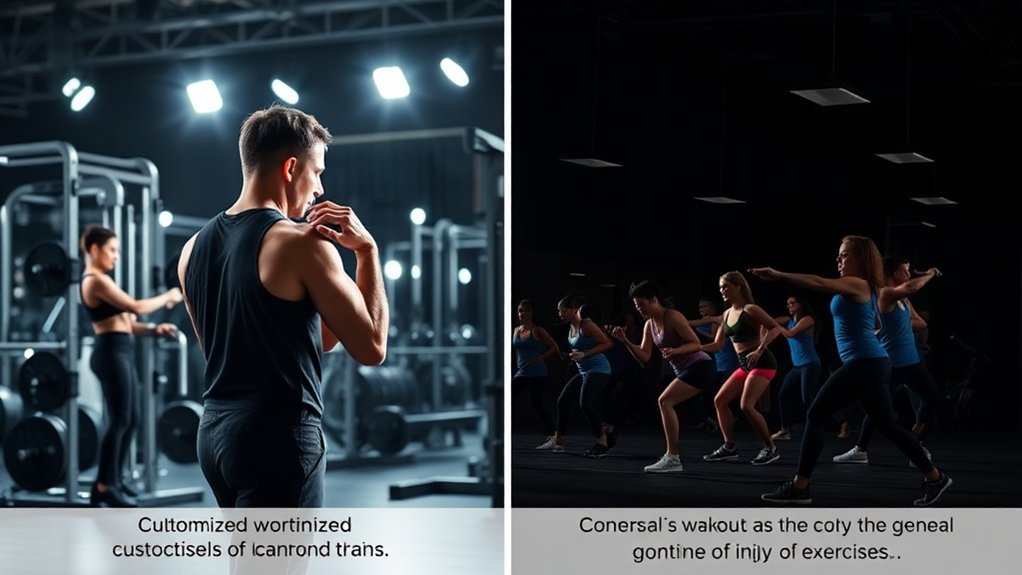
Your body’s unique biomechanics, injury history, and physical limitations require a systematic risk assessment before starting any exercise program.
Personalized plans incorporate this individual evaluation to identify vulnerable areas and movement dysfunctions that could lead to injury, while generic programs apply standardized exercises without accounting for your specific vulnerabilities.
This assessment enables your trainer to implement adaptive safety protocols—modifying exercises, adjusting load progression, and correcting form in real-time—rather than following a one-size-fits-all approach that may expose you to unnecessary risk.
Individual Risk Assessment Process
Before starting any exercise program, a thorough individual risk assessment identifies your specific vulnerabilities and establishes safety parameters for your training. This evaluation examines your movement patterns, injury history, and current fitness level through specialized assessment tools that reveal potential limitations requiring attention.
Your personalized risk evaluation addresses chronic conditions, muscular imbalances, joint restrictions, and cardiovascular considerations that generic programs typically ignore.
These assessment tools measure flexibility, stability, strength ratios, and functional movement quality to create a detailed risk profile.
This data-driven approach guarantees your workout plan accommodates your unique constraints while maximizing safety and effectiveness.
Without this individualized screening process, you’re fundamentally guessing which exercises suit your body’s capabilities, potentially setting yourself up for setbacks that proper risk evaluation would prevent.
Adaptive Safety Protocols
Adaptive safety protocols transform exercise prescription from a standardized approach into a dynamic system that responds to your body’s specific vulnerabilities. These protocols analyze your movement patterns and injury history to identify potential risks before they manifest.
Through continuous safety assessments, your trainer modifies exercises in real-time based on your current physical condition, preventing overtraining and reducing injury likelihood.
Generic programs can’t offer this responsiveness. They apply universal exercises without considering your limitations, potentially increasing injury risk through inappropriate selections.
Personalized training employs adaptive techniques that guarantee progression aligns with your recovery capacity and strengths. This ongoing monitoring identifies emerging concerns immediately, while standard programs lack the flexibility needed for effective risk management, leaving you vulnerable to preventable setbacks.
Real-World Scenarios: How Each Approach Handles Different Situations Over 4-12 Weeks
When you’re maneuvering real-world fitness challenges, the differences between personalized and generic workout programs become starkly apparent through specific scenarios.
Real life examples demonstrate this clearly: if you’re recovering from a knee injury, your personalized plan prioritizes rehabilitation exercises while avoiding high-impact movements that generic programs might include.
Over 4-12 weeks, you’ll receive weekly assessments and adjustments based on your progress, preventing plateaus that static generic programs create.
Success stories consistently show personalized plans incorporating adaptive nutrition aligned with your preferences, flexible scheduling for busy work commitments, and regular trainer check-ins that maintain accountability.
Generic programs typically lack these responsive elements—offering fixed schedules, minimal dietary guidance, and limited engagement—ultimately compromising your motivation, adherence, and results throughout the training period.
Decision Framework: When Generic Programs Work and When Personalization Becomes Essential

Understanding which workout approach fits your situation requires evaluating three critical factors: your current fitness foundation, specific objectives, and available resources. Generic program benefits include low-cost structure for beginners and general maintenance seekers. However, personalized training advantages become essential when addressing specific goals, health conditions, or progress plateaus.
| Situation | Generic Program | Personalized Plan |
|---|---|---|
| Fitness beginner with general goals | Appropriate starting point | Optional improvement |
| Specific goals (weight loss, muscle gain) | Insufficient targeting | Essential for results |
| Health conditions or injuries | Potentially unsafe | Medically necessary |
Your decision hinges on goal specificity and physical limitations. While generic programs offer accessible entry points, personalization becomes non-negotiable when safety, specialized outcomes, or sustained progress matter most to your fitness journey.
Evaluation Criteria: Key Signals to Assess Any Workout Program Before Starting
Before committing to any workout program, you’ll need a systematic evaluation framework that separates effective plans from potentially harmful ones.
Your workout evaluation should examine five critical elements: customization depth that addresses your fitness level, specific goals, and pre-existing conditions; program adaptability that evolves with your progress and changing schedule; ongoing support mechanisms like trainer check-ins and performance tracking to sustain motivation; safety protocols emphasizing proper technique and gradual progression; and structural balance incorporating strength, cardio, and flexibility with clear advancement strategies.
Programs lacking these elements often lead to plateaus or injuries.
Whether you’re considering generic or personalized options, this framework reveals which plans genuinely support your development versus those offering superficial solutions that won’t deliver sustainable results.
Frequently Asked Questions
How Much Does a Personalized Workout Plan Typically Cost Compared to Generic Programs?
You’ll typically pay $50-300 monthly for personalized plans versus $10-30 for generic programs. This cost comparison reveals personalized coaching provides tailored program benefits—customized exercises, form corrections, and progress adjustments—while generic programs offer basic, one-size-fits-all routines.
Can I Switch From a Generic Program to Personalized Training Mid-Way Through?
Yes, you can absolutely make the change. Changing programs mid-way demonstrates smart training flexibility. Most coaches welcome altering clients and will assess your current progress, adjust programming accordingly, and logically integrate your existing foundation into personalized training.
Do Personalized Workout Plans Require Special Equipment or Gym Membership?
Picture yourself training anywhere—your personalized plan adapts to your equipment accessibility, whether you’ve got dumbbells at home or full gym access. Home workouts work perfectly; trainers customize exercises based on what’s actually available to you.
How Long Does It Take to See Results With Personalized Versus Generic Programs?
You’ll typically notice results faster with personalized programs—often within 2-4 weeks versus 6-8 weeks for generic plans. This shortened time frame occurs because personalized progress tracking enables immediate adjustments targeting your specific body’s responses and adaptation patterns.
What Qualifications Should a Trainer Have to Create Personalized Workout Plans?
You’ll want a trainer with accredited certification requirements like NASM, ACE, or NSCA credentials, plus specialized certifications in your specific goals. Ideally, they’ll have 2-5 years of trainer experience working with clients similar to you.