
Your training volume adjusts based on your experience level, recovery capacity, and performance feedback. Beginners typically start with 6-8 sets per muscle group weekly, while advanced lifters may require 15+ sets. You’ll use autoregulation tools like RPE and RIR to gauge fatigue, then modify volume accordingly. Deload weeks every 3-6 weeks reduce volume by 40-60% to manage cumulative stress. When your goals shift or life demands increase, your volume adapts through continuous monitoring of strength patterns and recovery signals to optimize your results.
What Training Volume Means and How It’s Calculated in Strength Programming

When you’re building a personalized workout plan, understanding training volume forms the foundation of effective strength programming.
Training volume represents the total work you perform during each session, quantified through specific calculation methods that multiply sets, repetitions, and weight lifted. For instance, if you complete 3 sets of 8 reps at 135 pounds, your training volume equals 3,240 pounds (3 x 8 x 135).
This metric directly influences your muscle growth potential. As a beginner, you’ll typically start with 6-8 sets per muscle group weekly, while advanced lifters often require 15 or more sets to stimulate continued adaptations.
The Relationship Between Training Volume and Individual Goals (Strength, Hypertrophy, Endurance)
Your training volume directly impacts which adaptation your body prioritizes, making it essential to align volume with your specific fitness goal.
If you’re training for maximum strength, you’ll need lower total volume with heavier loads (5-10 reps for 3-5 sets) to optimize neural adaptations without excessive fatigue.
Conversely, building muscle size requires moderate to high volume (8-15 reps for 3-4 sets) to accumulate the metabolic stress and mechanical tension necessary for hypertrophy.
Strength Goals Require Lower Volume
While hypertrophy and endurance training thrive on higher volumes, strength development follows a different paradigm that prioritizes intensity over sheer workload.
Your strength adaptations occur most effectively when you’re lifting 85-95% of your one-rep max for 1-5 repetitions per set, targeting around 5-10 sets per muscle group weekly. This intensity focus drives the neuromuscular adaptations essential for maximal force production.
You’ll make better progress by incrementally increasing the weight you’re lifting rather than adding more sets or reps. This progressive overload approach prevents excessive fatigue while promoting proper recovery between sessions.
Unlike hypertrophy training, which requires 10-20 sets per muscle group weekly, your strength-focused program succeeds through strategic intensity management. This structured, lower-volume approach guarantees you’re maximizing strength gains without compromising recovery.
Hypertrophy Demands Moderate-High Volume
Building muscle mass requires a fundamentally different volume approach than strength training. Your hypertrophy training demands 10-20 sets per muscle group weekly to effectively stimulate growth. These volume considerations directly impact your results:
- Repetition Range: You’ll perform 6-12 reps per set, training near muscle failure to maximize muscle fiber recruitment.
- Progressive Overload: You must gradually increase volume by adding sets, reps, or weight to continually challenge your muscles.
- Recovery Balance: You need adequate rest between sessions, as excessive volume without recovery leads to overtraining.
This moderate-high volume approach creates the metabolic stress and mechanical tension necessary for muscle growth.
Baseline Volume Recommendations by Experience Level and Training Status

Your training volume needs to match your experience level to optimize results while minimizing injury risk.
Beginners require markedly fewer sets than advanced lifters because their nervous systems and muscles respond to lower stimuli, whereas seasoned athletes need greater training stress to continue adapting.
We’ll examine specific volume targets for beginner, intermediate, and advanced lifters so you can identify where you currently stand and adjust your program accordingly.
Beginner Volume Guidelines
As a beginner, you’ll achieve ideal muscle growth and sustainable progress by targeting 6-8 sets per muscle group per week. This volume supports beginner strength development while allowing adequate recovery between sessions.
Your training frequency should include 3-4 sets of 8-12 repetitions per workout, emphasizing compound movements that efficiently engage multiple muscle groups simultaneously.
Focus on these core principles:
- Prioritize technique over weight – Master proper form before increasing resistance to build a solid foundation.
- Progress gradually – Add sets or reps based on your recovery capacity and performance feedback.
- Monitor your response – Regularly assess comfort levels and adjust volume to prevent overtraining.
This structured approach guarantees your training remains effective and aligned with your fitness goals while minimizing injury risk during these vital early stages.
Intermediate Lifter Targets
Once you’ve established proper movement patterns and consistent training habits, intermediate lifters require 10-12 sets per muscle group per week to continue driving meaningful adaptations.
Structure your sessions with 3-4 sets of 8-12 repetitions, stopping 2-3 reps short of failure to maximize muscle adaptation while managing fatigue effectively.
Progressive overload becomes critical at this stage—gradually increase volume by adding sets or reps as your body adapts.
However, balance remains essential: higher training intensities demand lower volumes to guarantee proper recovery.
Monitor your performance consistently and adjust your volume accordingly to avoid plateaus.
Regular assessments of your strength gains, recovery capacity, and overall progress will guide these adjustments.
This individualized approach guarantees your training volume continues supporting your specific fitness goals without compromising recovery or performance quality.
Advanced Athlete Protocols
Advanced lifters who’ve exceeded intermediate training thresholds need a minimum baseline of 15 sets per muscle group weekly to sustain meaningful strength and hypertrophy gains.
Your advanced athlete strategies should incorporate personalized programming that adapts to your daily readiness and recovery capacity.
Optimize your training through these evidence-based protocols:
- Rep Range Precision: Target 6-12 reps per set, balancing mechanical tension with adequate volume accumulation.
- Strategic Periodization: Cycle between high and low volume phases to prevent adaptation plateaus while maintaining progressive overload.
- Auto-Regulation Implementation: Adjust training intensity and volume based on performance markers, soreness levels, sleep quality, and energy status.
Monitor these recovery metrics consistently to fine-tune your workload.
When life stressors increase, you’ll need corresponding volume adjustments to prevent overtraining while maximizing adaptations.
Weekly Progression Models: Linear, Undulating, and Block Periodization Approaches
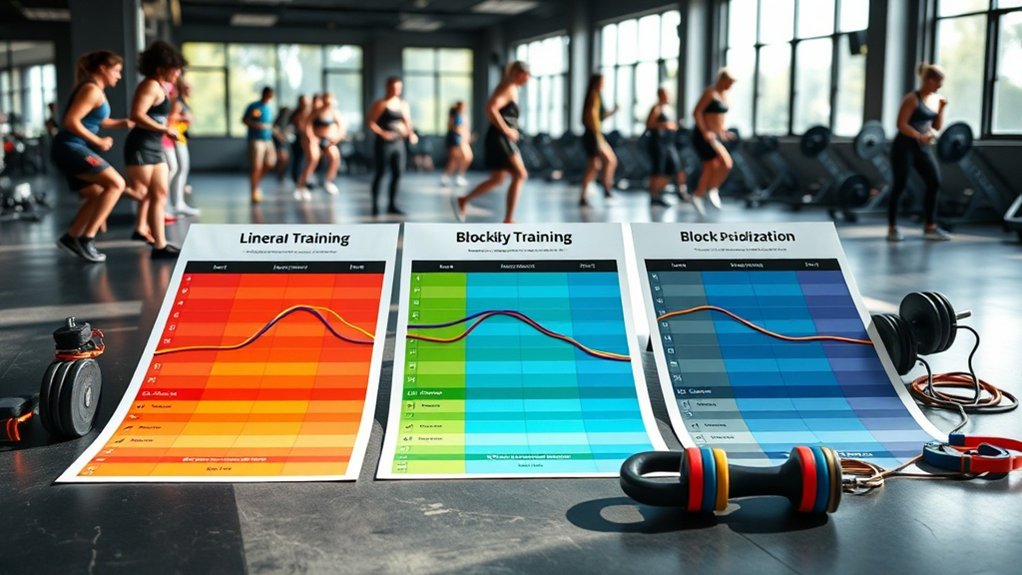
When you’re designing a workout plan that delivers consistent results, understanding periodization models becomes critical for long-term success. These approaches optimize training variety and maximize periodization benefits while preventing plateaus.
| Model | Key Characteristics |
|---|---|
| Linear | Gradually increases intensity and volume over weeks or months using consistent progression |
| Undulating | Alternates intensity and volume within each week, providing varied stimuli and recovery opportunities |
| Block | Dedicates specific time blocks to distinct goals like strength, hypertrophy, or endurance |
Your trainer should assess your fitness level and goals to select the appropriate model. Linear works well for beginners, undulating suits intermediate lifters needing recovery management, and block periodization optimizes advanced performance. Proper monitoring guarantees continuous progress while preventing overtraining.
Autoregulation Strategies Using RPE, RIR, and Readiness Assessments
While periodization models provide the structural framework for your training program, they can’t account for daily fluctuations in your performance capacity.
Autoregulation strategies bridge this gap by adjusting training volume based on real-time feedback. The autoregulation benefits include reduced overtraining risk and improved training outcomes through individualized responses to varying life stressors.
Three key autoregulation methods optimize your training adjustments:
- Rate of Perceived Exertion (RPE): You’ll rate workout difficulty on a 1-10 scale, with RPE accuracy improving as you gain experience tracking your effort levels.
- Reps In Reserve (RIR): You’ll assess how many additional repetitions you could complete before failure, typically maintaining 1-3 RIR for effective stimulus.
- Readiness Assessments: Your trainer evaluates sleep quality, stress levels, and fatigue to modify workout intensity accordingly.
Reading Fatigue Signals and Performance Trends to Guide Volume Adjustments

Your body communicates its recovery status through distinct fatigue signals that directly inform volume adjustments. Reading fatigue involves monitoring decreased motivation, increased joint discomfort, and inability to lift typical loads—all indicators requiring immediate volume reduction to prevent overtraining. Performance tracking complements this by documenting workout completion rates and strength progression patterns, revealing when your recovery capacity no longer supports current demands.
| Fatigue Signal | Volume Adjustment |
|---|---|
| Decreased motivation + joint pain | Reduce sets by 20-30% |
| Poor sleep + high external stress | Lower training frequency |
| Stalled strength progression | Implement deload week |
When sleep quality deteriorates or daily stress escalates, you’ll need corresponding volume reductions. Auto-regulation techniques—adjusting loads based on daily energy levels—make sure your training adapts to current physical and mental states, creating sustainable progression aligned with your evolving recovery capacity.
The Role of Recovery Cycles and Deload Weeks in Managing Cumulative Fatigue
Strategic recovery periods address cumulative fatigue that develops even when you respond appropriately to daily signals.
Deload strategies involve systematically reducing training demands every 3-6 weeks to optimize long-term adaptation. Effective fatigue management requires recognizing when your body needs structured recovery.
Implement deload weeks when you notice:
- Performance decline – Decreased strength, reduced endurance, or inability to complete previously manageable workouts
- Physical indicators – Persistent joint pain, prolonged muscle soreness, or heightened resting heart rate
- Mental signals – Lost motivation, increased irritability, or difficulty maintaining workout focus
During deload weeks, reduce training volume by 40-60% while maintaining frequency. This approach allows tissue repair and nervous system recovery without losing conditioning.
Properly timed recovery cycles prevent plateaus and optimize your body’s adaptive response to training demands.
Adapting Volume When Goals Shift or Life Stress Changes Training Capacity

Because your training capacity fluctuates with both internal goal shifts and external life demands, effective volume management requires continuous adaptation rather than rigid adherence to predetermined plans.
When shifting from strength training to hypertrophy, goal alignment necessitates increasing weekly sets from 6-8 as a beginner to 10-12 at intermediate levels. However, stress management becomes just as critical—work deadlines or personal challenges may require temporary volume reductions to prevent overtraining.
Auto-regulation provides the framework for these adjustments. You’ll monitor performance metrics like soreness, sleep quality, mood, and energy levels to determine your current recovery capacity.
This feedback-driven approach prevents the common pitfall of increasing volume without purpose, which leads to ineffective outcomes and injury risk. A flexible plan that respects both your goals and recovery capacity maintains progress sustainably.
Frequently Asked Questions
How to Calculate Training Volume?
Want ideal results? You’ll calculate training volume by multiplying sets × reps × weight lifted. This metric, combined with tracking your training intensity and workout frequency, helps you measure progress and adjust your personalized plan effectively.
What Is the 3-3-3 Rule in Working Out?
The 3-3-3 rule means you’ll perform three exercises, each for three sets, targeting different muscle groups. These 3 3 3 workouts use moderate-to-high training intensity with compound movements, making certain balanced development while allowing proper recovery between sessions.
What Is the 2 2 2 Rule in Gym?
The 2-2-2 rule is a gym principle where you’ll add two more reps, increase weight by two pounds, or add two sets each workout. It’s an effective workout strategy for progressive overload and consistent strength gains.
How to Manage Training Volume?
You’ll manage training volume by balancing training frequency with your recovery capacity. Start with 6-8 sets per muscle group weekly, then adjust based on soreness and energy. Implement recovery strategies like deload weeks every 3-6 weeks to prevent overtraining.