You’ll build a more effective workout plan by using RPE (Rate of Perceived Exertion) to adjust intensity based on how your body actually feels each day. Start by establishing your baseline across easy (RPE 2-4), moderate (RPE 5-6), and hard (RPE 7-9) zones, then modify sessions according to daily stress, sleep, and recovery status. For strength, target RPE 7-9 with heavier loads, while hypertrophy requires RPE 6-8 with moderate weights. This evidence-based approach prevents overtraining while maximizing results, and there’s much more to uncover about optimizing your training response.
What Is RPE and Why It Matters for Your Training
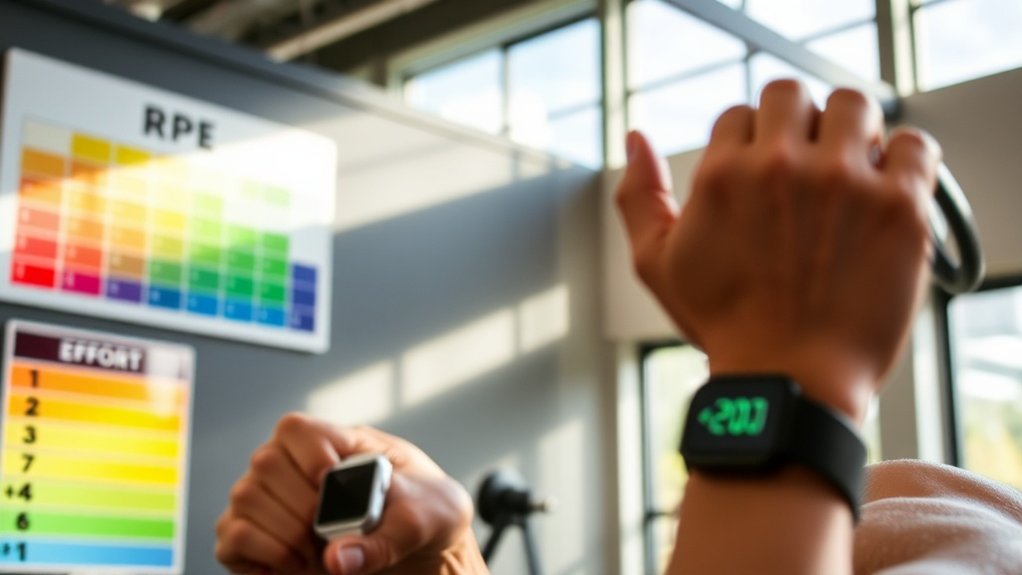
Rate of Perceived Exertion (RPE) transforms how you measure workout intensity by replacing rigid formulas with your body’s honest feedback. This 0-10 scale lets you assess effort based on what you’re actually feeling—not what a device dictates.
You’ll gain vital self-awareness about your limits and how daily stressors impact performance. RPE benefits extend across all training types.
You’ll prevent both under-training and over-training by tracking your scores consistently. This data-driven approach optimizes your pacing and recovery strategies without expensive equipment.
RPE applications work especially well in endurance sports and resistance training. You’ll adjust workouts based on your physical and mental state each day, making certain you train smart rather than just hard.
You’re building sustainable fitness through personalized intensity management.
Understanding the RPE Scale and RIR System
Knowing RPE’s value means little without understanding how to apply it systematically. The 0-10 scale gives you clear benchmarks: 1-2 represents minimal exertion, while 9-10 signals maximal effort. You’ll assess your physical state during each exercise, adjusting intensity based on personal feelings rather than arbitrary numbers.
RIR applications improve this approach by estimating repetitions remaining before failure. If you’re at RPE 7 with 3 RIR, you could perform three more reps.
Research confirms RPE benefits extend beyond simple measurement—combining both systems creates training flexibility that responds to daily readiness. You’ll modify workouts in real-time according to actual capability, not predetermined targets.
This integration aligns workout loads with your perceived effort, increasing performance outcomes through personalized intensity management.
How RPE Translates to Relative Load Prescriptions

When you apply RPE to determine training loads, you’ll transform subjective effort into concrete weight selections for each exercise.
RPE applications allow you to adjust intensity based on your daily physical state—if you’re rating 6-7, you’re working at moderate loads, while 8-10 signals high-intensity efforts.
Research confirms that RPE benefits include superior training adaptations because you’ll develop an intuitive understanding of your capabilities and limits.
In resistance training, higher repetition ranges naturally increase your RPE, enabling precise workout adjustments.
This approach prevents overtraining and injury by encouraging you to listen to your body’s signals.
You’ll make smarter load decisions that align with your recovery status, making sure consistent progress without compromising safety or performance quality.
Building an RPE-Based Personalized Workout Plan
To create your RPE-based workout plan, you’ll start by evaluating your baseline RPE across different exercise types, which gives you a reference point for gauging intensity throughout your training cycle.
Once you’ve established these baselines, you’ll set weekly intensity targets that distribute easy (RPE 2-4), moderate (RPE 5-6), and hard (RPE 7-9) sessions according to your specific goals and recovery capacity.
You’ll then adjust these prescribed intensities based on daily variations in fatigue, stress, and sleep quality, making sure your training load matches what your body can handle each day.
Assess Your Baseline RPE
Before you can build an effective RPE-based workout plan, you’ll need to establish your personal baseline by testing how your body responds to different exercise intensities.
Perform exercise variety at different intensities over one week, rating your perceived exertion on a 1-10 scale during each session. Document where you feel comfortable and where exertion becomes challenging.
Pay attention to fatigue effects and external factors like sleep quality and stress, as these greatly influence your perceived exertion. Your recorded data will reveal patterns showing how your body responds to varying intensity levels.
Use these insights to adjust your training intensity according to your personal capabilities.
Reassess your baseline RPE every few weeks to account for fitness improvements and recovery changes, confirming your workout plan remains accurate and personalized.
Set Weekly Intensity Targets
Your weekly training structure needs clear intensity targets distributed across three distinct RPE zones to maximize adaptation while preventing burnout.
Allocate 60-70% of your sessions to easy intensity (RPE 2-4), 20-30% to moderate effort (RPE 5-6), and 10-20% to hard training (RPE 7-9). This intensity balance prevents overtraining while driving meaningful progress.
Use RPE feedback from completed workouts to adjust upcoming sessions. If you’re consistently hitting RPE 8 when targeting RPE 6, scale back your next workout.
During interval training phases, target RPE 7-9, then prioritize recovery importance by scheduling RPE 2-4 sessions afterward.
Track your RPE scores weekly to identify patterns requiring adjustment. Communicate how you’re feeling before each session, making certain your targets match your physical and mental readiness for peak personalization.
Adjust for Daily Variations
While your training plan provides essential structure, real performance depends on adapting to how you feel each day. Daily fluctuations in fatigue, stress, and sleep quality directly impact your RPE scores, signaling when personalized adjustments are necessary.
Track your RPE consistently to identify patterns that reveal ideal training windows versus recovery needs. When your RPE registers higher than expected for a planned workout, reduce intensity or volume to match your current capacity. This prevents overtraining and minimizes injury risk.
Conversely, lower-than-anticipated RPE scores indicate readiness to push harder. These personalized adjustments empower you to take control of your training through real-time feedback. By aligning workout intensity with your body’s daily signals, you’ll increase performance while assuring adequate recovery for sustainable progress.
RPE Targets for Strength Goals Vs Hypertrophy Goals
Your RPE targets should differ considerably based on whether you’re prioritizing strength or hypertrophy, as each goal demands distinct training intensities and volume schemes.
For strength development, you’ll need to work at RPE 7-9 with heavier loads and lower reps (1-6) to maximize neuromuscular adaptations.
In contrast, hypertrophy training requires RPE 6-8 with moderate weights and higher reps (6-12) to optimize muscle growth through increased time under tension and training volume.
Strength Training RPE Guidelines
The intensity at which you lift determines whether you’ll maximize strength or muscle growth, making RPE selection critical for goal-specific programming. For strength development, you’ll target RPE 7-9, focusing on near-maximal efforts that stimulate neurological adaptations and force production. These high-intensity lifts should leave you capable of 1-3 additional reps maximum.
Common RPE misconceptions include believing all training requires maximum effort. Strategic RPE applications actually involve cycling intensities—you’ll benefit from periodizing loads based on daily readiness rather than pushing RPE 9-10 constantly.
Monitor your perceived exertion to prevent overtraining; when recovery feels compromised, scale back intensity. This self-regulation protects against injury while maintaining consistent strength gains.
Adjust loads session-by-session, making sure you’re training within ideal ranges that match your current capacity and long-term strength objectives.
Hypertrophy Training RPE Guidelines
Because muscle growth responds most effectively to accumulated training volume rather than pure intensity, you’ll target RPE 6-8 for hypertrophy-focused sessions—a notably lower range than strength-specific training.
This moderate intensity allows you to complete higher repetition ranges and multiple sets without excessive fatigue, which are fundamental hypertrophy strategies that stimulate muscle fiber adaptation.
You’ll adjust your RPE based on daily recovery status and training frequency, personalizing each workout to your current capacity. This approach prevents overtraining while maintaining sufficient stimulus for growth.
When you’re operating at RPE 6-8, you’re leaving 2-4 repetitions in reserve, which enables you to manage cumulative fatigue across multiple training sessions per week.
Tracking Progress and Adjusting Intensity With RPE
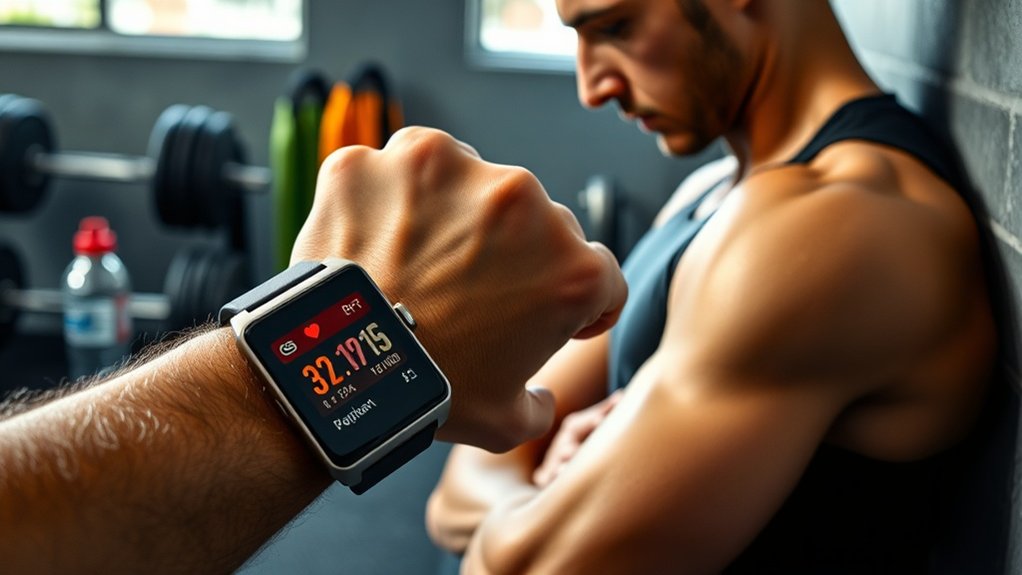
When you track your RPE scores consistently across workouts, you’ll uncover patterns that reveal how your body responds to different training stimuli. These insights enable you to make data-driven adjustments to your training intensity and recovery protocols.
| RPE Score | Action Required | Training Adjustment |
|---|---|---|
| Lower than expected | Increase intensity | Add weight or volume |
| Matches expected | Maintain plan | Continue as programmed |
| Higher than expected | Reduce intensity | Decrease load or rest |
Despite RPE advantages in personalizing your training loads, RPE challenges include subjective interpretation variability. Monitor discrepancies between your expected and actual perceived exertion to identify when modifications are necessary. This approach prevents overtraining while optimizing performance gains, confirming your capacity for recovery matches your training demands.
Using RPE to Prevent Overtraining and Manage Recovery
Smart tracking of your RPE scores does more than optimize individual workouts—it safeguards against the cumulative stress that leads to overtraining.
RPE benefits include early detection of overtraining signs like persistent fatigue and declining performance, allowing you to intervene before serious problems develop.
You’ll prevent excessive fatigue by adjusting your training loads based on daily RPE fluctuations. When you’re feeling run-down, your heightened RPE at standard intensities signals the need for recovery.
Keep challenging sessions (RPE 7-9) limited to a few weekly occurrences while incorporating lighter days (RPE 2-4) to maintain balance.
This personalized approach guarantees you’re designating effective rest days when your body needs them most, reducing injury risk and supporting long-term performance gains rather than pushing beyond sustainable limits.
RPE Vs Percentage-Based Programming: When to Use Each
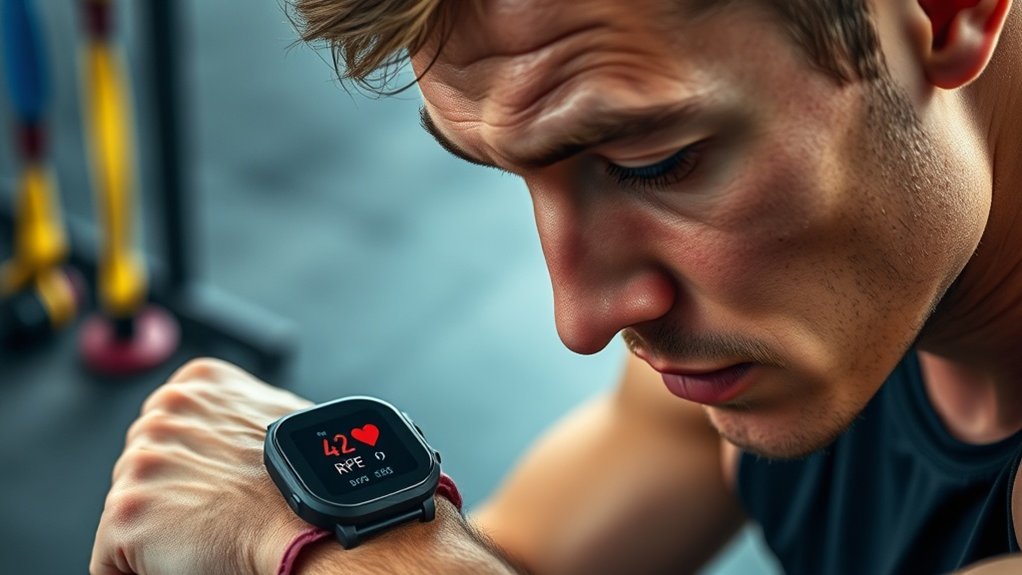
While RPE and percentage-based programming both structure your training intensity, they serve distinct purposes that depend on your experience level, recovery status, and workout context.
You’ll find RPE benefits most valuable when you’re managing fluctuating energy levels or learning proper training adaptability. This athlete intuition-driven approach lets you respond to daily variations in stress, sleep, and recovery without compromising your workout quality.
Conversely, percentage-based programming excels when you need precise load management and systematic progression tracking. If you’re an advanced lifter with established performance baselines, percentages provide consistent benchmarks for improvement.
You can combine both methods strategically: use percentages for primary compound movements requiring precise loads, while applying RPE for accessory work where programming flexibility matters most.
This hybrid approach optimizes both structure and responsiveness.
Implementing Daily RPE Adjustments for Optimal Results
Because your body’s readiness varies from day to day, you’ll achieve better results by adjusting your training loads based on real-time RPE feedback rather than rigidly following predetermined weights.
These daily adjustments enable performance optimization by matching intensity to your current physical and mental state. Track your perceived exertion in your training log to identify patterns in fatigue, stress, and recovery.
When your RPE climbs unexpectedly during warm-up sets, reduce volume or intensity accordingly. This approach prevents overtraining and injury while maintaining training effectiveness.
Frequently Asked Questions
Can RPE Be Effectively Used for Cardio and Endurance Training?
Yes, you’ll find RPE benefits cardio training exceptionally well. It helps you monitor intensity without equipment, making sure proper endurance adaptations. You should use RPE 5-7 for steady-state work and RPE 8-9 for high-intensity intervals to optimize your cardiovascular fitness gains.
How Do Beginners Learn to Accurately Gauge Their RPE Levels?
You’ll learn accurate RPE scales through consistent practice matching effort descriptions to sensations. Start with beginner techniques like tracking breathlessness and talk-test ability during workouts. Record your ratings post-exercise, then compare them to objective metrics like heart rate for calibration.
Does RPE Work for Group Fitness Classes or Team Sports?
You’ll find RPE absolutely essential for group fitness classes and team sports! It helps you monitor your personal intensity variation despite group dynamics, making certain you’re training at your ideal level rather than simply matching others’ pace.
Can RPE Replace Heart Rate Monitors for Tracking Workout Intensity?
You can use RPE instead of heart rate monitors, but understand its limitations. RPE accuracy depends on your self-awareness and experience level. You’ll get best results combining both methods, especially when you’re learning to gauge intensity correctly.
How Does Illness or Medication Affect RPE Accuracy?
When you’re feeling under the weather, illness impact and medication influence can skew your RPE perception. You’ll need to adjust your intensity expectations downward, as both factors artificially raise your perceived exertion beyond actual physical output.